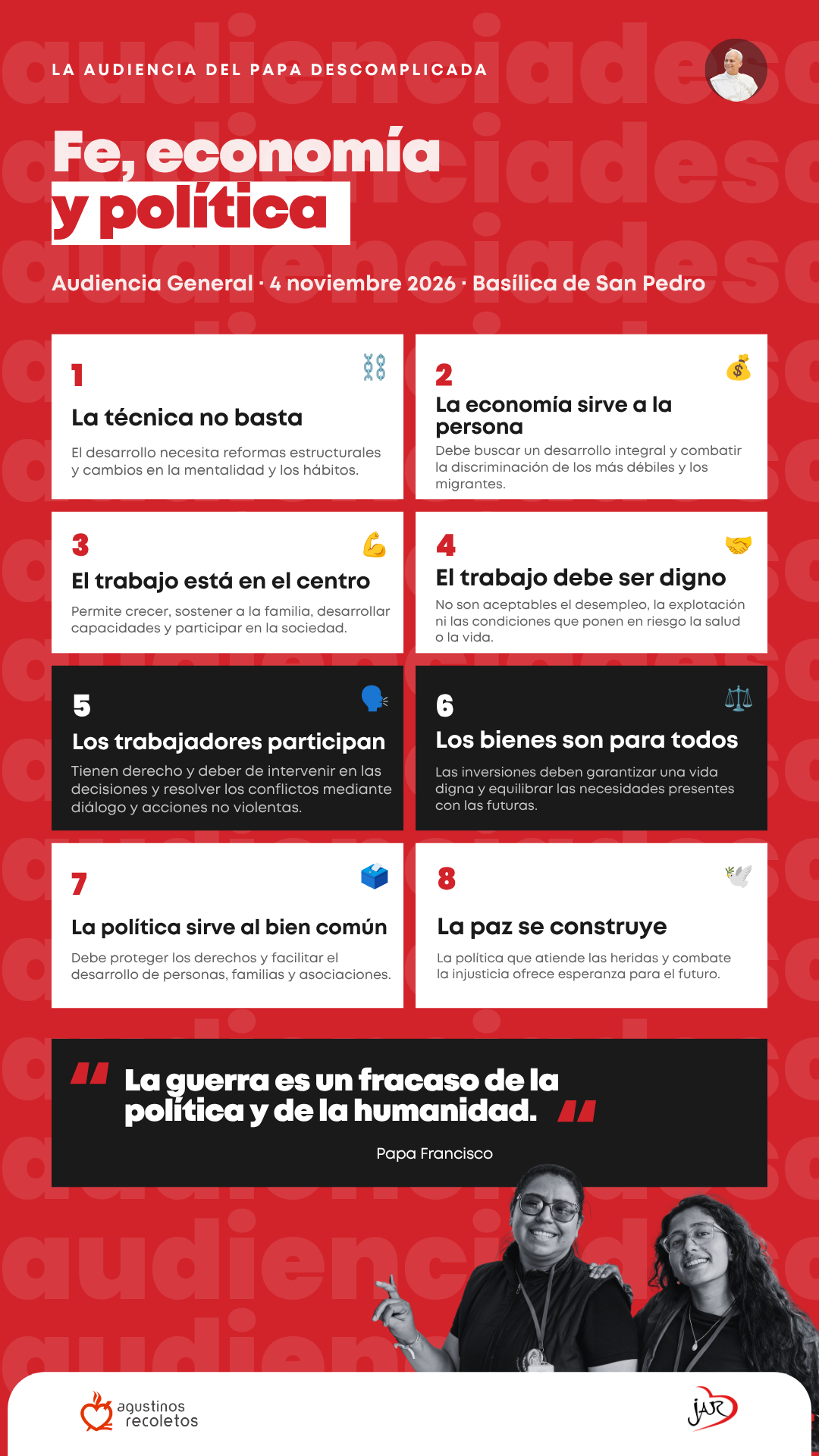

Summary: In the General Audience of November 4, 2026, Pope Leo XIV continued his catechesis on Gaudium et spes. This week he explained that the Christian faith also offers criteria for the economy, work, and politics: human dignity, justice, participation, the common good, and peacebuilding.
What do faith, economy, and politics have to do with each other? Much more than it seems. In the General Audience of November 4, 2026, Pope Leo XIV explained that the social dimension is part of both human nature and our faith in Jesus Christ.
Continuing his catechesis on the pastoral constitution Gaudium et spes, the Pope addressed economic, social, and political life. Faith doesn’t offer a technical program to solve every problem, but it does provide criteria to discern how to build a society that respects dignity and serves the common good.
Economic growth is not enough
The Council warned about the imbalances caused by economic development that is unjust and shows little respect for creation. These inequalities don’t just hurt those who suffer them directly; they also endanger world peace.
To correct the course, achieving more technical development isn’t enough. Gaudium et spes states that reforms in economic and social structures are necessary, but so is a change in mindset and lifestyle habits. We can’t demand a fairer system while our daily decisions continue to fuel inequality or the deterioration of creation.
An economy at the service of people
The economy must always be at the service of the human being and remain under their responsibility. People cannot become tools of a system whose only goal is to produce, grow, or accumulate.
Authentic development must be integral—meaning it must benefit the whole person and not just one dimension of their life. It must also fight against discrimination that harms the weakest social groups and migrants.
Work is the heart of the economy
The Pope reminded us that work occupies a central place in economic life. Through it, a person grows, provides for their family’s needs, expresses their abilities, participates in society, and collaborates with God’s creative work.
That’s why work cannot be used against people, the common good, or creation. When an activity destroys health, puts life at risk, or reduces a person to a tool, it stops fulfilling its true function.
Talent needs opportunities
Society must offer everyone the possibility to develop and use their abilities. Unemployment, exploitation, and dangerous working conditions cannot be considered inevitable consequences that we must simply accept.
The dignity of work demands real opportunities, health protection, and respect for life. A person’s talent cannot bear fruit when they are denied the chance to participate or forced to work in undignified conditions.
Workers must also be able to decide
Workers have the right and the duty to participate in decisions related to their activity. This participation can also be developed through associations that allow them to jointly defend their rights and legitimate interests.
When conflicts arise, the path must be dialogue and non-violent action. Participation doesn’t seek to turn every disagreement into a confrontation, but to recognize that those who do the work must have a voice in the decisions that affect their lives.
The goods of the earth are for everyone
One of the fundamental principles of the Church’s social teaching is the universal destination of goods. The earth’s resources are not intended solely for the benefit of a few people or groups.
This principle must also guide finance and investment. Those who organize economic life have the responsibility to guarantee the goods necessary for a dignified life and to seek a fair balance between current consumption and the needs of future generations.
Thinking beyond immediate profit
An economic decision shouldn’t be valued only by the profits it produces today. It’s also necessary to ask how it will affect the community, creation, and those not yet born tomorrow.
The Pope thus invites us to overcome a short-sighted economy. Investing and organizing resources requires responsibility toward current needs, but also foresight and care for the future.
What does politics exist for?
Gaudium et spes values the efforts to build political and legal systems that better protect people’s rights. This search stems from a deeper awareness of human dignity.
The political community exists to serve the common good, not to exclusively benefit those who exercise power. Its mission is to create the conditions that allow individuals, families, and associations to develop as fully as possible.
Power also has limits
Political authority can be organized in different ways depending on the history and circumstances of each place. However, it must always be oriented toward the common good and maintain an open outlook toward the good of the entire human family.
Exercising power doesn’t mean being able to do anything. Authority finds its meaning when it protects rights, facilitates people’s development, and serves the community.
Church and political community: distinct, but able to collaborate
The Council affirms that the Church and the political community are independent and autonomous within their own spheres. Neither should take over the mission that belongs to the other.
However, both serve the same people in different ways. Therefore, healthy collaboration can make their service more effective and produce benefits for everyone.
Politics can also build peace
Committing to the economy and politics following these criteria is a concrete way to build peace. Injustice, inequality, and lack of participation end up creating wounds that can fuel new conflicts.
The Pope recalled a statement by Francis: “War is a failure of politics and of humanity, a shameful surrender, a defeat before the forces of evil.” Instead, politics that attends to the wounds of peoples and those who suffer injustice offers reasons to hope for the future.
A special invitation to young people
Leo XIV encouraged young people to follow the example of men and women who have given a good witness in the economy and in politics. He didn’t present these fields as inevitably corrupt spaces that a Christian should stay away from.
The answer lies in participating with a formed conscience and an authentic will to serve. To do this, the Pope asked Christian communities to once again promote formation in the social doctrine of the Church.
Final greetings: justice, dialogue, and peace
In his greetings to pilgrims of different languages, the Pope asked that Christian communities become places of peace and justice. He also invited those with political responsibilities to work for the common good and protect the gift of peace.
Recalling the liberation of Cardinals Stefan Wyszyński and József Mindszenty, he insisted that peace is built through justice, respect for the law, and dialogue, not through violence. He reminded Arabic-speaking pilgrims that work and social participation must serve the common good, protect human dignity, and build peace.
A new trip through South America
In his greeting to Spanish-speaking pilgrims, the Pope announced that the following Friday he would begin an apostolic journey to Uruguay, Argentina, and Peru. He asked for prayers so that this visit would strengthen faith, renew hope, rekindle charity, and boost the joyful announcement of the Gospel.
Leo XIV again asked for the accompaniment of prayer before starting the trip. He presented these countries as especially beloved places and entrusted the mission to God’s blessing.
New blesseds and the example of Saint Charles Borromeo
The Pope announced two beatifications for Saturday, November 7. In Antigua Guatemala, Augusto Rafael Ramírez Monasterio, a Franciscan priest murdered out of hatred for the faith in 1983, would be beatified; in Santander, Francisco González de Córdova and seventy-nine companions, including priests, seminarians, and laity, would be beatified.
At the end of the audience, he also recalled the liturgical memorial of Saint Charles Borromeo. He invited young people, the sick, and newlyweds to let themselves be led by Christ in daily life, following the example of this bishop animated by an ardent love for the Lord.
The idea made simple
Faith isn’t limited to your private prayer, nor does it end when you leave church. It also influences how you work, consume, invest, participate in society, and understand power.
A truly human economy doesn’t turn people into tools. It offers dignified work, allows for participation in decisions, cares for creation, and thinks about both present needs and future generations.
Good politics doesn’t just seek to conquer or keep power either. It protects rights, heals wounds, promotes the common good, and builds peace through justice, the law, and dialogue. That’s why Christians aren’t called to escape these fields, but to get formed and participate in them with consistency.