
The liturgy has to be able to speak to you
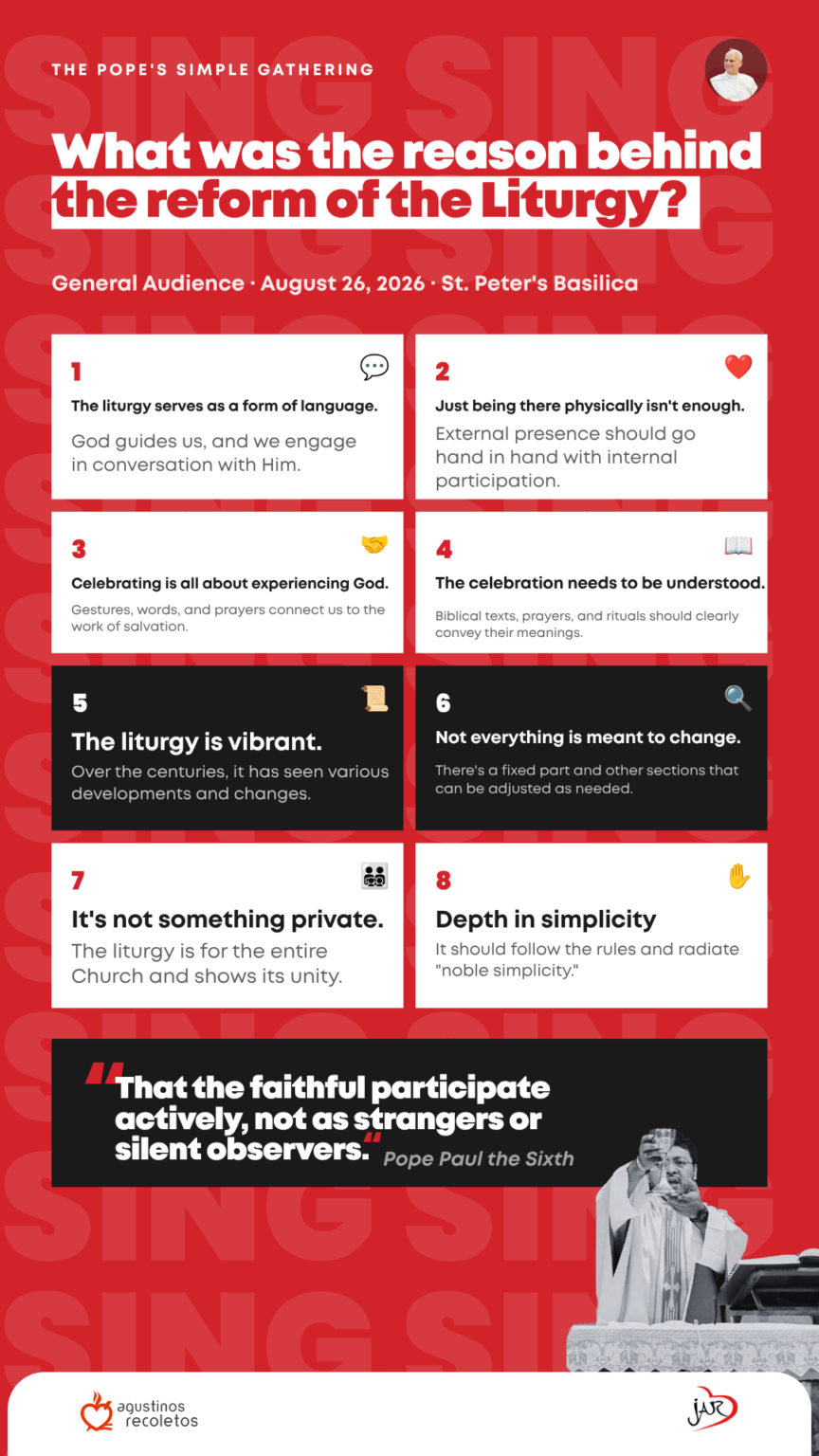
The Pope recalled a reflection by the then Cardinal Giovanni Battista Montini, the future Saint Paul VI: the liturgy expresses both the divine and the human. It is a language through which God teaches us and we enter into dialogue with Him.
That is why the liturgy also fulfills a formative role. It must allow faith and prayer to be expressed in an understandable way.
If people don’t understand the rites and prayers, it becomes harder for them to truly participate in the celebration.
The reform specifically sought to make the richness of biblical texts and prayers more accessible to everyone. It also aimed to make the structure of the celebration clearer.
At Mass, we aren’t watching from the outside
The constitution Sacrosanctum Concilium expresses a very specific concern: that the faithful do not attend the liturgy “as strangers or silent spectators.”
Participating doesn’t just mean being inside a church or watching what the priest does.
It means understanding the rites and prayers, letting yourself be formed by the Word of God, feeding on the body of the Lord, giving thanks, and learning to offer your own life.
The liturgy makes the work of salvation present and allows us to enter into a true relationship with God. That is why the gestures and words of the celebration are important.
We are not at a show, but inside a celebration that also involves us.
Why was a reform necessary?
The liturgical reform put what constitutes the heart of the Church’s experience at the center.
The Pope presented the liturgy as “the primary source of that divine exchange in which God’s life is communicated to us.”
From this conviction arose the need to facilitate the faithful’s access to the richness of biblical texts and prayers. It also sought to make the order of the celebration clearer than what was established in the liturgical books used until then.
The goal was to help the Christian people better understand the meaning of what they celebrate and to participate in a full, active, and communal way.
Does changing the liturgy mean breaking with tradition?
No. The Pope explained that the liturgy is a living reality and that, throughout the centuries, it has always experienced developments and changes.
The council constitution itself distinguishes between an immutable part, being of divine institution, and other parts that can change.
These latter parts may need a revision when they no longer adequately express the nature of the liturgy or have ceased to be appropriate.
The goal was not to abandon tradition, but to make its richness better understood and lived.
The liturgical reform promoted by the Second Vatican Council is, therefore, within the living tradition of the Church.
The reform didn’t appear out of nowhere
The desire for a general reform of the liturgy did not arise unexpectedly.
The Pope recalled that the pontiffs of the first half of the 20th century had already promoted various changes. Among them were interventions on the Holy Week rites and a simplification of the rules for the Breviary and the Missal.
The concern to prevent the faithful from being mere spectators had also appeared before the Second Vatican Council.
The conciliar reform was, therefore, part of a path that was already being traveled within the Church.
Participating actively doesn’t mean making things up
Active participation does not turn the liturgy into something that each person, priest, or community can modify according to their preferences.
The Pope warned about the abuses that occurred in some sectors of the Church after the Council and that can still occur when the principles of the reform are exaggerated or misinterpreted.
Liturgical celebrations are not private actions. They are celebrations of the Church and belong to its whole body.
The liturgy manifests the unity of the holy people gathered and organized under the guidance of their pastors.
Simplicity doesn’t mean superficiality
Bishops and priests have the responsibility to guard and promote a liturgy faithful to its norms and characterized by a “noble simplicity.”
The simplicity of the liturgy does not seek to empty it of meaning. It seeks to allow what we celebrate to manifest itself with clarity, beauty, and depth.
When lived this way, the liturgy also becomes a fundamental instrument of evangelization.
Through it we receive grace, learn to offer our own lives, and grow in unity with God and with others.
Final greetings: a faith lived every day
In the greetings to pilgrims of different languages, the Pope returned to several ideas related to the catechesis.
He invited them to participate actively in the liturgy, to open their hearts and minds to the living presence of Christ, to seek God with perseverance, and to live their faith consistently.
He also addressed particular messages to different groups. He remembered the elderly and those who care for them, and spoke about the protection of human life, the care of marriage and the family, the education of children and young people, and the commitment to justice and fraternity.
To the young people who had received Confirmation, he reminded them that the Holy Spirit “is not a treasure to be kept hidden,” but a light they must make shine every day.
Saint Monica and Saint Augustine: seeking the truth together
Addressing the young, the sick, and newlyweds, the Pope recalled the upcoming liturgical celebrations of Saint Monica and Saint Augustine.
He presented them as two great saints united on earth by their family ties and, in heaven, by the same destiny of glory.
Their example, he explained, can awaken in each person a sincere and passionate search for the truth of the Gospel.
But that search doesn’t end when we discover the truth. The Pope also invited them to bear witness to it with joy in daily life.
Put simply: faith is not a treasure to hide nor a truth to be kept only for oneself. It is a light that must be reflected in our way of living.