


Friar Alfonso Dávila shares with us a pastoral perspective on the need to be seen, to leave a mark, and to find a greater battle. The battle our young people are fighting right now.
For several days now, I’ve been asking myself what this idea of aura farming truly means. On social media, videos appear of young people challenging each other with poses, dances, gestures learned on TikTok, and references that, I confess, often go over my head. Up until then, I might have thought it was just another one of those trends that flash across the screen and disappear with a swipe.
But the other day, walking near my home, the screen became a public square. In the emblematic Plaza de Pablo Ruiz Picasso, at the foot of Madrid’s Torre Picasso, I saw groups of young people gathering. Don’t ask me for an exact number, because I’m terrible with figures, but there were hundreds, as the media also reported. Suddenly, what I had been observing from afar for days was right there: occupying public space, making noise, laughing, and seeking to be seen.
Most of them would have been between fourteen and twenty years old. This age group includes the last members of Generation Z and the first of Generation Alpha; generational boundaries are never exact. They do share something crucial: six years ago, during the pandemic, they went through a significant part of their childhood or adolescence locked down, interacting through screens and watching uncertainty enter their homes. These are the young people we find—or sometimes don’t find—in our parish contexts today.
What does aura farming mean?
“Farming” comes from video game language: repeating certain actions to accumulate resources, experience, or items to strengthen one’s character. “Aura,” in this jargon, doesn’t have a mystical meaning. It’s presence, style, confidence, that magnetism that makes someone seem special without too much obvious effort. Aura farming would, therefore, be accumulating gestures capable of increasing one’s charisma in the eyes of others.
The expression began circulating on TikTok in 2024. One of the first documented uses appeared on January 28 of that year, when a user posted a video of an outing with friends accompanied by the phrase aura farming. It later gained traction in communities related to video games, anime, and memes.
However, the expression found a globally recognizable image the following year. Rayyan Arkan Dikha, an eleven-year-old Indonesian boy, appeared dancing with dark glasses on the bow of a long boat during the Pacu Jalur, a traditional race in Riau province. His movements seemed spontaneous and calm while dozens of rowers propelled the canoe.
The internet saw in him the perfect definition of “aura”: effortless confidence. The video ended up making him a tourism ambassador for Riau. The story has something beautiful about it: behind the meme wasn’t a manufactured studio gesture, but a community tradition, a difficult task, and a child who had taught himself to maintain balance.

There is, moreover, something valuable that we shouldn't lose sight of: these young people have stepped away from the screen. They meet face-to-face, occupy a public square, recognize common codes, momentarily overcome the fear of ridicule, and build belonging.

The so-called aura battles bring the meme to the street. Two participants respond to each other with movements, poses, pirouettes, or nods to video games and anime, and the audience decides with their shouts who has won. There’s no real scoreboard, although the internet plays at adding and subtracting thousands of imaginary points. The most curious rule is also the most revealing: if it’s too obvious that you’re trying to have aura, you lose it.
The unwritten rules are easy to recognize. Staying calm, improvising with wit, helping without showing off, demonstrating skill without arrogance, or maintaining one’s own style “adds aura.” Losing composure, copying others, or visibly striving to appear interesting subtracts from it. Even falls and awkward moments are scored jokingly.
There’s no real accounting; it’s a playful way of talking about the impression we leave on others. But the vocabulary matters, because it reveals what qualities they admire and what they fear: authenticity, confidence, the group’s gaze, and, above all, the fear of giving cringe in front of everyone.
We can look at all this with superiority and conclude that it’s nonsense. It would be easy, but also unfair. We were young once too, and we had codes that our elders didn’t understand. Some of us were emos, others rappers, goths, skaters, or anything else that seemed incredibly important at the time. The difference is that we didn’t carry a permanent camera in our pockets, nor was there a network capable of preserving every ridiculous moment forever.
There is, moreover, something valuable that we shouldn’t lose sight of: these young people have stepped away from the screen. They meet face-to-face, occupy a public square, recognize common codes, momentarily overcome the fear of ridicule, and build belonging. The organizers of some meetups explain it as “a symbol of connection among us.”
In a generation that we so often accuse of living in isolation, perhaps we should start by celebrating that they gather. Before asking what’s wrong with it, we should ask them what they find there that they aren’t finding elsewhere, perhaps not even in our communities.
When the game becomes work
Understanding doesn’t mean giving up thinking. Aura farming reflects a very present temptation in our time: to turn one’s entire life into a scoreboard. Byung-Chul Han has pointed out how even leisure can become trapped by the logic of performance. Resting, playing, exercising, traveling, or showing ourselves on social media cease to be activities valuable in themselves and become tasks to improve our public persona.
Philosopher C. Thi Nguyen calls “value capture” the process by which a simple metric ends up replacing what it was intended to represent. Our values begin rich and subtle; then we find a simplified, quantifiable version, and that version ends up taking its place.
We start walking for health and end up walking to close our watch rings. We join a network to communicate and end up writing to maximize reactions. Similarly, we can seek friendship, beauty, or recognition and end up pursuing only aura points.
The problem isn’t playing at scoring a pose. The game knows its points are provisional and can teach us creativity, discipline, and humor. The risk appears when we forget that the scoreboard was a metaphor.
Charisma, friendship, or beauty are complex, open, and changing realities. If we reduce them to followers, applause, or aura, we run the risk of living to improve the outcome and forgetting the fundamental question: what life is truly worth living?
This isn’t an accusation against young people. Adults do exactly the same thing when we measure our worth by productivity, salary, miles traveled, books read, or the impact of a homily. They didn’t invent the performance society; they’ve learned to speak its language with a creativity that seems strange to us. If we want to accompany them, perhaps the first conversion must be our own.

It's not something within me, but between us
Harmunt Rosa

Perhaps saving what is beautiful, even in our young people, consists of opening spaces where they don't have to be impeccable or interesting all the time.
Saving the beautiful: making space for mystery
In The Salvation of the Beautiful, Han describes contemporary aesthetics as a smooth beauty: polished, immediately pleasing, and ready to receive a “like.” He formulates it with a brief, harsh sentence: “The beautiful is exhausted in the ‘like.'”
It is a beauty without resistance, which completely surrenders to the gaze. But true beauty doesn’t end with a “wow.” It maintains a distance, a wound, a fragility; it doesn’t just please, it also unsettles us and can transform us.
That’s why Han also states that “transparent beauty is an oxymoron.” The beautiful needs a veil: something that isn’t fully displayed, that requires time, contemplation, and respect.
Applied to aura, this means that a person isn’t more authentic just by showing everything. Having interiority means reserving a space that doesn’t belong to the public, the group, or the algorithm. A mentor/guide can help protect that space without turning it into a shameful secret: teaching that not every moment needs to be recorded and that some experiences grow precisely because they are not published.
Here lies the paradox of aura. Authentic charisma isn’t entirely manufactured. It’s born in encounter, in a person’s story, in the way they listen, in vulnerability that doesn’t need to be displayed, and in the good done when no one is recording.
Hartmut Rosa would say it belongs to the realm of resonance: something touches us, we respond, and we are transformed, but we cannot program or guarantee it. “It’s not something within me, but between us,” Rosa explains. The aura that matters wouldn’t be a property I possess, but a relationship that happens. Trying to make that experience fully available ultimately extinguishes it.
Perhaps saving what is beautiful, even in our young people, consists of opening spaces where they don’t have to be impeccable or interesting all the time. Spaces without a scoreboard, where they can be bored, make mistakes, be silent, share a wound, or discover a question. Places where someone looks at them not because they’ve won over the audience, but because their life is already valuable.
The Christian community should be able to offer precisely that: a gaze that doesn’t consume and a presence that doesn’t demand a show.
Accompanying Amidst the Battles
Cardinal Fernando Chomali has taken this youth expression to propose another direction: “the best way to farm aura is to embrace life with hope and joy.” He then invites us to study, prepare body and soul, and put our capacities at the service of others.
I like the intuition, as long as it’s not just about appropriating their language to preach a sermon. The Gospel doesn’t need to disguise itself as a meme; it needs to offer companionship.
Accompanying will mean approaching the square, learning some names, asking what they enjoy, and listening to the answer. It will also mean being there when the battle ends, when the video doesn’t work, when shame sets in, or when applause isn’t enough.
Young people need pastors and mentors who remain close, just as someone remained close to us when we had emo fringes, rapped on a bench, or sought our place in ways that make us smile today.
The best way to farm aura is to embrace life with hope and joy
† Card. Fernando Chomali
Four movements for accompaniment
First, approach before interpreting. We don’t need to master their dictionary or pretend to be one of them. Honest curiosity is enough: “What do you like about this?”, “How do you decide who wins?”, “How do you feel when it’s your turn to perform?” A good question recognizes that the young person is the subject of their experience, not an object we must analyze.
Second, celebrate what is already alive. There’s play, physicality, creativity, courage to expose oneself, and a desire to belong. There’s also a risk of mockery, group pressure, and a need for approval, but pastoral correction begins better from the good we see than from the danger we fear. Those who feel recognized can listen; those who feel judged learn to hide.

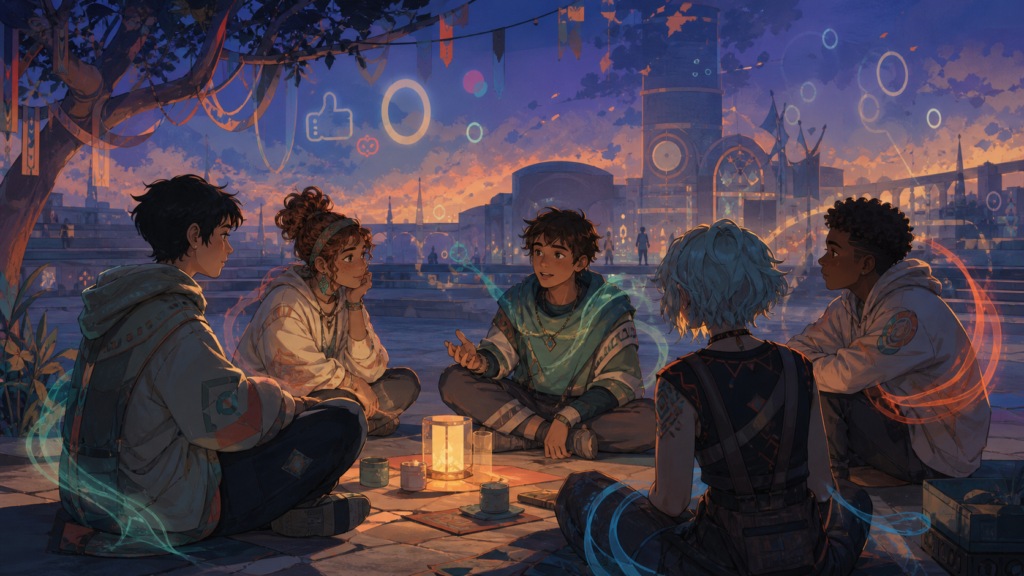
Third, offer places without a scoreboard. A post-meal conversation, a walk, a small group, a moment of prayer, or a service task where no one has to impress. It’s not about prohibiting the camera, but about making another experience possible: discovering that I can be received when I’m quiet, when I don’t know what to say, or when something goes wrong.
And fourth, remain. Many youth activities gather people for a few hours; Christian accompaniment begins when the spotlights dim. Remaining means remembering a name, asking again, holding a wound, and allowing time for the question of God to emerge without forcing it. Resonance, Rosa reminds us, is only possible “with trust and time, and without fear.” Perhaps that is a good description of all youth ministry.
An Augustinian intuition: changing the battle
There’s an intuition from Saint Augustine that can help us look at all this more deeply. In De vera religione, Augustine doesn’t begin by despising our desires, as if everything we seek were wrong from its root. He asks what good we are seeking, even when we seek it poorly.
Behind pleasure, curiosity, the desire to excel, or the need to win, there remains a longing for something true. Our desires can become disordered, but they retain a memory of the beauty for which we were created. That’s why Augustine even asks what thing could not serve as a reminder of that first Beauty we have abandoned.
The desire for aura could also be one of those reminders. Wanting to be seen, admired, recognized, or remembered doesn’t make a young person superficial. These desires speak of a deeper human need: for our life to matter, for our existence to leave a mark, and for someone to recognize something valuable in us.
The problem arises when we ask the public’s gaze for what that gaze cannot give us. Applause can acknowledge a performance, but not sustain an identity. A video can preserve an image, but not tell us who we are. A crowd can shout our name and, yet, not know us.
Augustine writes: “We want to be invincible, and that is very reasonable.” He doesn’t immediately condemn that desire. He recognizes that there is a legitimate aspiration within us not to be subjugated, not to live defeated. But he immediately shifts the battleground. We worry too much that another might defeat us and too little that our own anger, envy, fear, or need for approval might defeat us.
The decisive battle, therefore, is not about imposing oneself on another young person. It is about becoming free from what can dominate us from within. The truly invincible person is not one who ensures no one humiliates them, but one who does not surrender their worth to what another can give or take away.
Here, the most famous phrase from this text gains its full force: “Do not wish to be scattered abroad; enter into yourself, for in the inner man dwells truth.”
Entering within does not mean isolating oneself, indulging in one’s own emotions, or constructing an even more perfect inner version of our image. Augustine adds that, upon discovering our changeability, we must transcend ourselves. Christian interiority does not end with the self. It is the path by which we stop living scattered among the gazes of others and open ourselves to a Truth that we have not manufactured.
Perhaps that is the great contribution we can offer as mentors. Not denying the need to be seen, but helping it not to be captive to any gaze. Not ridiculing the desire to leave a mark, but guiding it towards a life that can truly bear fruit. Not extinguishing the desire to win, but showing that there are victories that liberate and others that, even if they receive thousands of applause, end up enslaving.

Being There When the Battle Ends
We can help them discover a greater battle, not against other young people or against their desire to be seen, but in favor of a full life. If we want to play along, we could say there are millions of aura points there; faith calls it eternal life, and it is not conquered like a trophy, but received as a gift that commits all freedom.
Ignatius of Loyola had to learn, after dreaming of external exploits, that the decisive combat was fought within. Augustine offers us a similar compass: to stop pouring ourselves out into external gazes, to enter into ourselves, and to discover that the truth of our life does not depend on the audience. There are no spectators there, no algorithm, and no points can be bought.
Perhaps our task is not to teach them how to gain aura, but to accompany them until they discover that they have already been seen and loved. That their worth does not depend on holding a pose. That the deepest mark is not always the one that gathers the most witnesses, but the one left by service, friendship, hope, and dedication.
And that, when this trend passes and the next one arrives, they can still find us there, between battles.
Sources and further reading
El Español: young people explain why they organize these battles.
C. Thi Nguyen, “Gamification and Value Capture,” in Games: Agency as Art, Oxford University Press.
Hartmut Rosa: “Everything goes so fast that we lose touch with life”.
