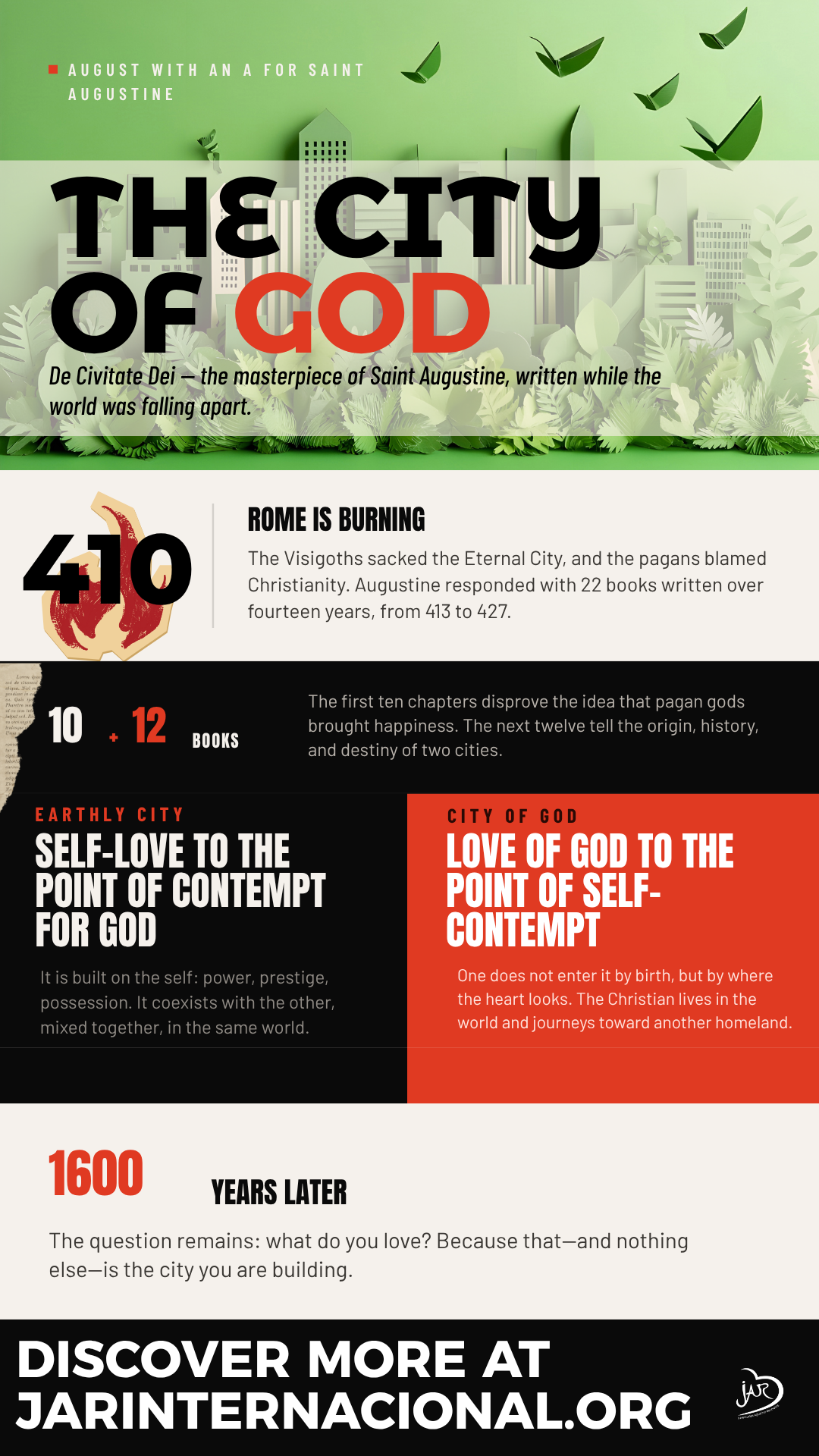


We close “August with A for Augustine” with The City of God, the work in which the saint responded to the fall of Rome and explained the two cities.
It was the year 410 when Rome, the city believed to be eternal, was sacked by Alaric’s Goths. The impact was such that many pagans pointed to a culprit: Christianity. By abandoning the ancient gods, they said, the Empire had lost its protection. Augustine, bishop of Hippo, did not let the accusation pass. Between 412 and 426 he wrote a response that would become one of the most influential works in the history of the West: The City of God (De Civitate Dei).
It is not a brief or light book: it comprises twenty-two books that combine theology, philosophy, history, and politics. But its heart can be summed up in an insight that continues challenging us 1,600 years later.
A response in two movements
Augustine organizes the work into two major blocks. In the first ten books he refutes the idea that the pagan gods were necessary, either for earthly prosperity or for eternal life. Rome did not fall because of the Christians, he argues, but because no human city is safe from the fragility that is its own.
In the following twelve books he unfolds the true project of the work: to tell the origin, historical development, and final destiny of two cities that, from the beginning of the world, have lived intermingled with each other.
Two cities, two loves
The key to the entire work lies in a phrase Augustine leaves near the end: there are two cities formed by two loves. The earthly city is born from love of self carried to the point of contempt for God. The City of God is born from love of God carried to the point of contempt for self (civ. Dei ciu. 14.28).
These are not two geographical places, nor two opposing organizations—Augustine is clear that both cities are intermingled in every human society, in every age, even within each person. They are two possible directions of the heart: to live oriented toward oneself, or to live oriented toward God and, from there, toward others.
What does it mean, then, to be a “citizen”?
Here Augustine makes a turn that was strange for his time. For the ancient world, to be a citizen was to belong to a specific political order: the Greek polis, imperial Rome. Augustine universalizes the idea: one belongs to the City of God not by the place where one is born, but by where one’s will is directed.
This does not make him a thinker who despises politics, though he has sometimes been presented that way. Augustine recognizes the value of public order, defends that Christians must fulfill their civic duties, obey just laws, and serve the common good; he even develops there the foundations of what would later become just war theory. His point is not to flee the world, but to inhabit it as a pilgrim: committed to the earthly city, without mistaking it for one’s true homeland.
A work that has not stopped speaking to us
The City of God shaped political theology throughout the Middle Ages, and its shadow reaches into modern debates about the relationship between religion, power, and society. But before being a treatise on politics, it is a personal invitation: to ask ourselves where we place our love, because—according to Augustine—that is where, deep down, we decide which city we belong to.
This August, as we celebrate the feast of Saint Augustine, it is a good occasion to return to that question he himself asked before writing it: not how much we possess or where we live, but where the heart is walking toward.