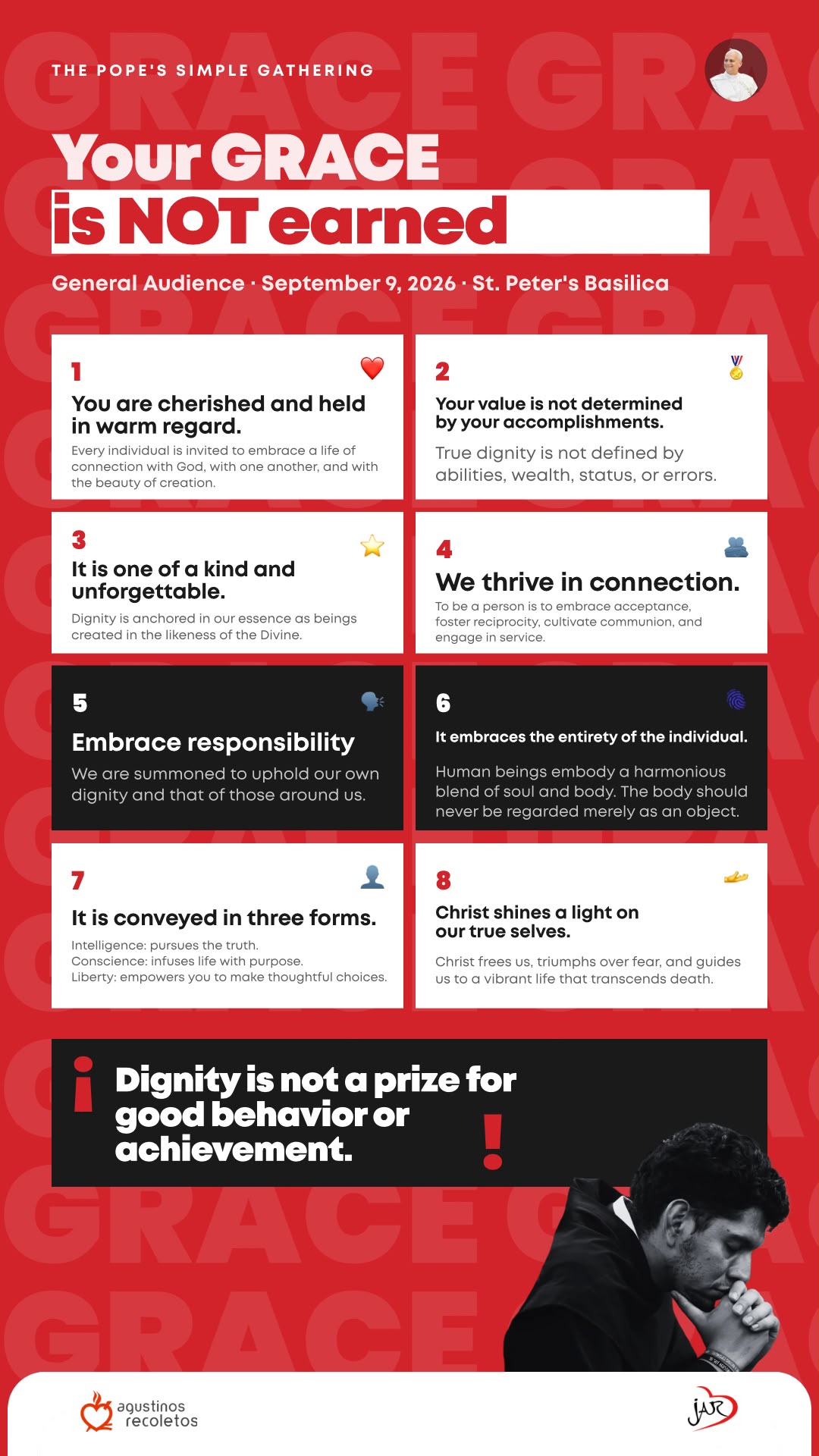

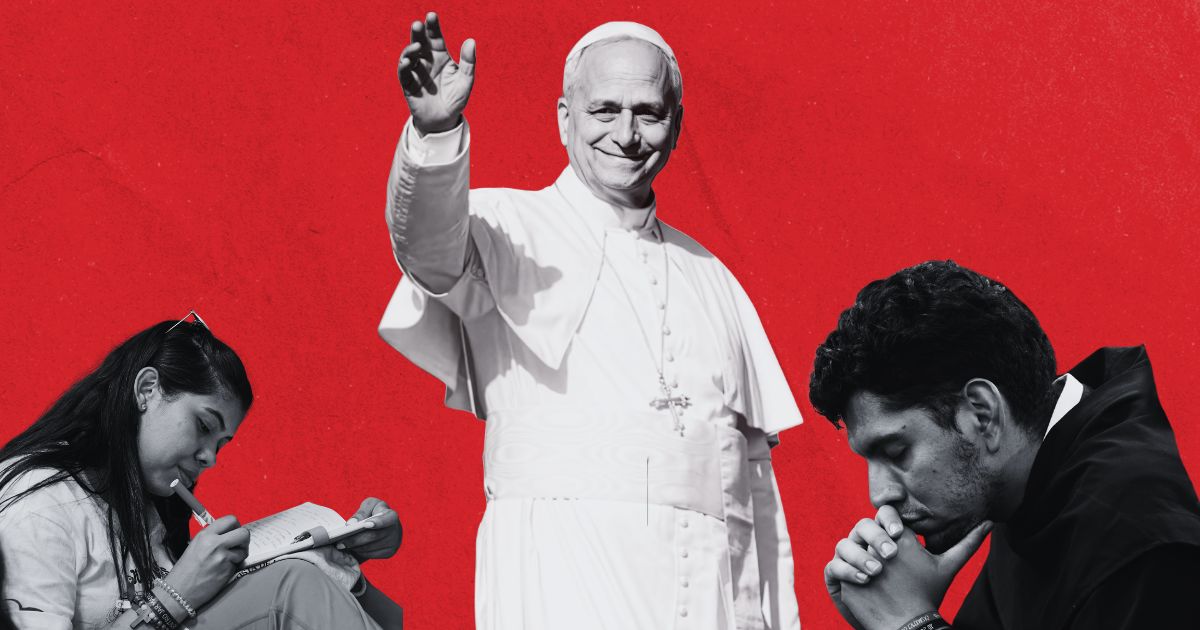
Summary: At the General Audience on September 9, 2026, Pope Leo XIV continued his catecheses on Gaudium et spes. This week, he explained that human dignity is a gift from God: it doesn’t depend on our abilities, wealth, roles, or decisions, but it does commit us to respecting and defending it in all people.
What determines a person’s worth? Their abilities? Their money? Their job? Their successes? The right or wrong decisions they’ve made?
At the General Audience on September 9, 2026, Pope Leo XIV clearly answered: none of those things are the foundation of our dignity.
Continuing the new series of catecheses on the pastoral constitution Gaudium et spes, the Pope explained that human dignity is both a gift and a responsibility.
It’s a gift because we receive it before we prove anything. And it’s a responsibility because we are called to recognize, promote, and defend it, both in ourselves and in others.
Your Worth Doesn’t Depend on What You Have
The Pope recalled that the recognition of the fundamental rights and traits of human dignity constitutes one of the most important pages in our history.
However, that journey is not yet over. Contradictions, both old and new, continue to exist, preventing the dignity of all people from being fully respected.
The Church’s contribution stems from a fundamental idea: dignity is born from the very being of the person.
Leo XIV expressed this through a quote from his encyclical Magnifica humanitas:
“Every person is thought of and willed by God to enter into a history of communion with Him, with others, and with creation.”
Therefore, dignity does not depend on:
- The abilities a person possesses.
- Their wealth.
- The role they play.
- Their right decisions.
- Their wrong decisions.
Dignity is a gift that precedes and surpasses all of that. God grants it as an expression of a love that never fades.
You Don’t Have to Prove You Deserve to Be a Person
We are used to measuring worth by results: grades, work, money, productivity, popularity, or mistakes made.
However, human dignity does not function as a reward. It doesn’t increase when you succeed or disappear when you fail. Nor does it depend on other people recognizing your worth.
As the Pope explained, the infinite dignity of the human being is rooted in their condition as a creature made in the image of God, capable of knowing and loving their Creator.
Faith allows us to understand this foundation even better. Christ, by revealing the mystery of the Father and His love, also fully shows the human being who they are and what their highest vocation is.
To Be a Person Means to Live in Relationship
Dignity does not lead to individualism or self-enclosure. For the Pope, being a person always implies relationship, communion, and participation. It means living a filial relationship with God and a fraternal relationship with Christ and with all human beings.
Therefore, the person is not made for self-referential attitudes. They are called to recognize themselves as a gift that can be shared.
We grow and mature when we learn to welcome others, to live reciprocity, and to serve.
Simply put: discovering your dignity isn’t about thinking you’re more important than others. It’s about recognizing that your life has a received value and that the lives of others possess that same value.
A Gift That Also Demands Responsibility
Dignity is a gift, but it is entrusted to each person’s responsibility. Defending it requires solidarity and mutual care. It also implies recognizing and overcoming the falsifications and manipulations that distort our way of understanding the human being.
The Pope recalled that the person experiences an inner division and that human life, both individual and collective, is marked by a dramatic struggle between good and evil, between light and darkness.
Our fragility, however, does not have the last word. We can contemplate it with hope because Christ has come to liberate the human being, give them strength, and renew them from within.
Your Body Is Not an Object
Gaudium et spes teaches that dignity encompasses the entire person. The human being is a unity of soul and body. Therefore, we must overcome any view that treats the body as if it were something separate from the person or an object that can be arbitrarily disposed of.
The human body is good and worthy of respect because it has been created by God and is destined for resurrection. At the same time, the Pope recalled that we are all wounded by sin. Respecting the body also does not mean turning every impulse or desire into something automatically good.
Dignity calls for caring for the whole person: their body, their interiority, their relationships, and their vocation.
Intelligence, Conscience, and Freedom
The Pope highlighted three great expressions of human dignity that appear in Gaudium et spes:
Intelligence
Makes the human being an tireless seeker of truth.
Conscience
Helps give unity and meaning to one’s life and allows one to recognize the truth.
Freedom
Makes the person a responsible protagonist of their decisions. These three dimensions are deeply related. Freedom does not simply consist of doing anything. In conscience, we recognize the truth, and that truth offers freedom a foundation and a possibility to choose responsibly.
A Freedom That Conquers Fear
The Holy Spirit gives us life in Christ, makes us free, and constantly reminds us of our dignity as children of God.
That freedom helps us overcome fear and guides us towards the full life that Christ has promised beyond death.
In Christ, we find light to understand the mystery of the human being, suffering, and death. With Him, we walk towards resurrection. Our dignity does not disappear in the face of fragility, pain, or death. It has a destiny that goes beyond them.
The Final Greetings: Defending Dignity in Real Life
In his greetings to pilgrims of different languages, the Pope invited them to marvel at the dignity received from the Creator and to promote it in the various environments of life.
He also asked for fruits for efforts aimed at promoting peaceful coexistence, recalled that praising God is our highest vocation, and invited them to show the living face of Christ through faith and works.
The Pope also spoke of the freedom granted by the Holy Spirit, the care for the dignity of each person, and the work of farmers, thanks to whom daily food is not lacking.
He encouraged Spanish-speaking pilgrims to re-evaluate and promote in themselves and in others the unique and indelible dignity received as beings created in the image of God and redeemed by Christ.
Mary: A Life Accompanied by Her Example
Addressing the elderly, young people, the sick, and newlyweds, the Pope recalled that the previous day had been the liturgical feast of the Nativity of the Blessed Virgin Mary.
He asked that her example and maternal intercession inspire and accompany their lives.
The idea made simple
You don’t need to prove you deserve dignity. Your worth doesn’t depend on what you produce, how much you have, the role you play, or whether all your decisions are correct.
Your dignity is a gift from God. It is unique, prior to your merits, and indelible. But receiving this gift also commits you. If you recognize your dignity, you must learn to defend that of all people, care for your body, seek the truth, form your conscience, and responsibly exercise your freedom.
Dignity is not a medal to feel superior. It is a call to live in communion, reciprocity, and service.