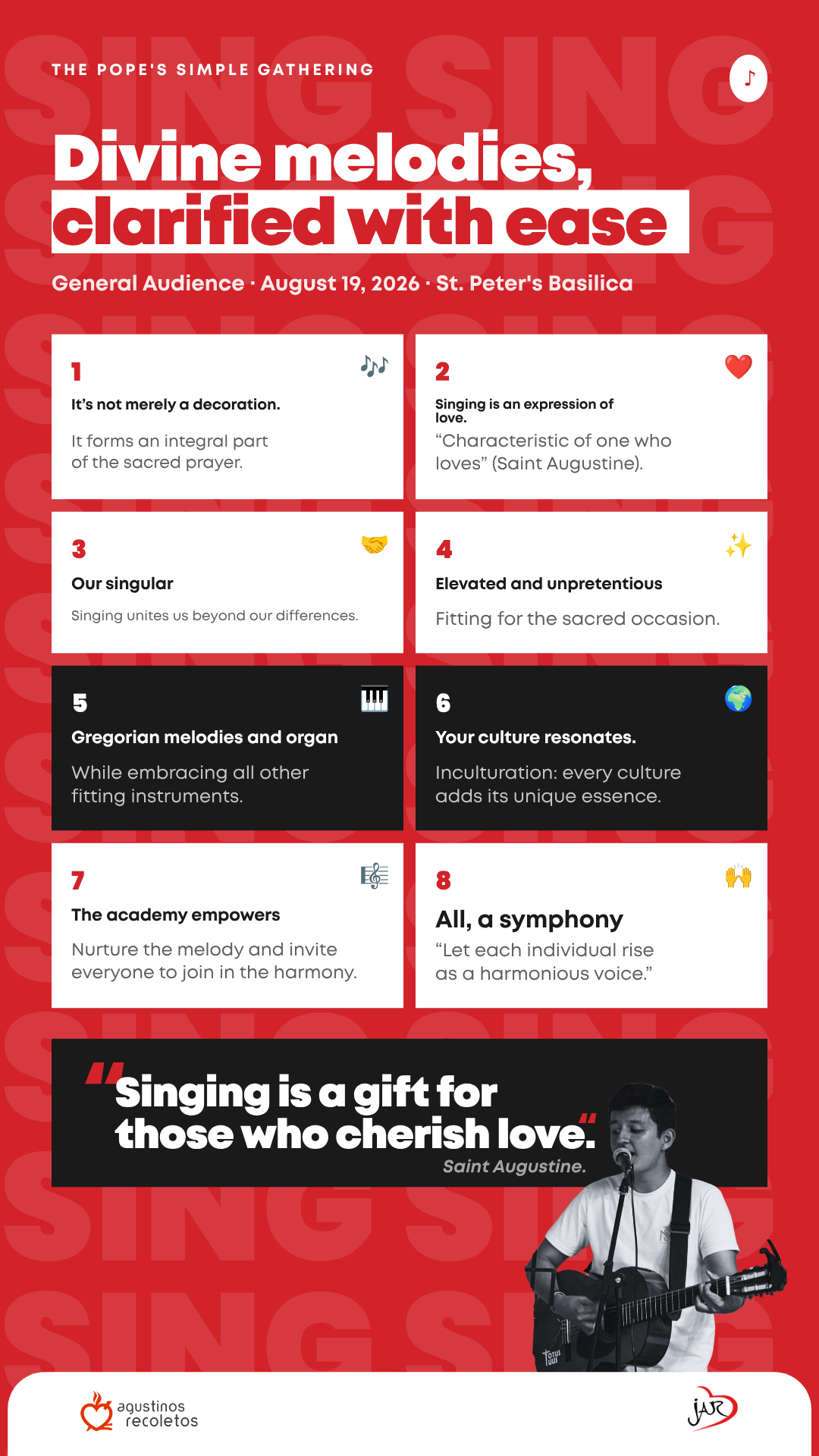

In his general audience on August 19, 2026, Pope Leo XIV explained that sacred music is not a mere embellishment of the Mass: it is prayer, it fosters the unity of the faithful, and it is part of the liturgical action. We’ll tell you the key points of his catechesis clearly and simply.
Pope Leo XIV’s Uncomplicated Audience, the new JAR Internacional format
JAR Internacional premieres “Pope Leo XIV’s Uncomplicated Audience”, a new format where, every Wednesday, we will explain the central message of the Holy Father’s general audience in a simple and accessible way: what he said, why it’s important, and how it can illuminate our daily lives.
The general audience is Pope Leo XIV’s weekly meeting with the faithful and pilgrims who travel to Rome. It usually takes place on Wednesdays and includes a brief catechesis, readings, and greetings addressed to people from different countries.
Simply put, it’s like a great “masterclass” from the Pope for the entire Church: a space for teaching, encounter, and pastoral closeness. And that’s precisely what we’ll do in this new format: simplify his words to better understand them and put them into practice.
What did Pope Leo XIV talk about on August 19, 2026?
The general audience on August 19, 2026, was held in St. Peter’s Basilica. Pope Leo XIV continued his cycle of catechesis on the documents of the Second Vatican Council and dedicated his reflection to the sixth chapter of the Constitution Sacrosanctum Concilium, focusing on sacred music.
The Pope recalled that the Church’s musical tradition constitutes “a treasure of inestimable value.” Sacred song, united with words, is not something added to the celebration from outside, but a necessary and integral part of the solemn liturgy.
Singing at Mass is not decoration: it is prayer
This was one of the main ideas of the catechesis: liturgical music does not serve only to beautify the Mass or fill moments of silence.
When a community sings during the liturgy, it is praying. The voices and hearts of the faithful unite with each other and turn towards God, actively participating in the mystery being celebrated.
Pope Leo XIV summarized it with an expression from Saint Augustine:
“Singing is for one who loves.”
The original phrase, Cantare amantis est, shows that singing is born of love and expresses the affective dimension of prayer. Singing helps to open the heart to grace and to allow oneself to be transformed by God.
Did Saint Augustine say that “he who sings prays twice”?
The well-known phrase “he who sings prays twice” is often attributed to Saint Augustine, but it does not appear in that exact form in his writings nor was it the expression used by Pope Leo XIV in this audience.
The Pope quoted a different and documented formulation: “Singing is for one who loves.” However, the popular phrase conveys a related idea: when singing is truly united with prayer, words, music, and heart become one single praise.
Liturgical song unites the community
Sacred music also fosters communion. By singing together, the faithful overcome their differences and form a single voice of praise.
As the Pope explained, this harmony transforms singing into a visible manifestation of the Church. It is not about one person or group standing out, but about the entire assembly participating as one body.
Therefore, liturgical singing cannot be understood solely as a musical performance: it is at the service of prayer and the participation of the community.
What should the music at Mass be like?
Following the teachings of the Second Vatican Council, Pope Leo XIV pointed out that the music and texts used in the liturgy must meet several characteristics:
- Be appropriate for each moment of the celebration and not depend solely on trends.
- Have a noble and, at the same time, simple form.
- Possess musical quality and be able to be performed by the assembly.
- Use profound texts, but easy to understand.
- Be inspired primarily by Sacred Scripture, liturgical books, and the spiritual tradition of the Church.
The fundamental criterion is not whether a song is old or modern, but whether it helps to pray, respects the dignity of the celebration, and fosters the participation of the faithful.
Gregorian chant, the organ, and other instruments
The Second Vatican Council grants a special place to Gregorian chant, although it does not exclude other genres of sacred music.
It also particularly recognizes the value of the organ. Other instruments may be used when they are appropriate for worship, respect the dignity of the temple, and truly contribute to the spiritual edification of the faithful.
The music of each people also has a place
Pope Leo XIV also spoke of inculturation, that is, the integration of the cultural expressions of each people into the life of the Church.
Local musical traditions are part of the religious and social life of communities. Therefore, when they are compatible with the liturgy, they can be promoted both in celebrations and in schools.
The Church can praise God with diverse voices, melodies, and instruments without losing the unity of faith.
The mission of the schola cantorum
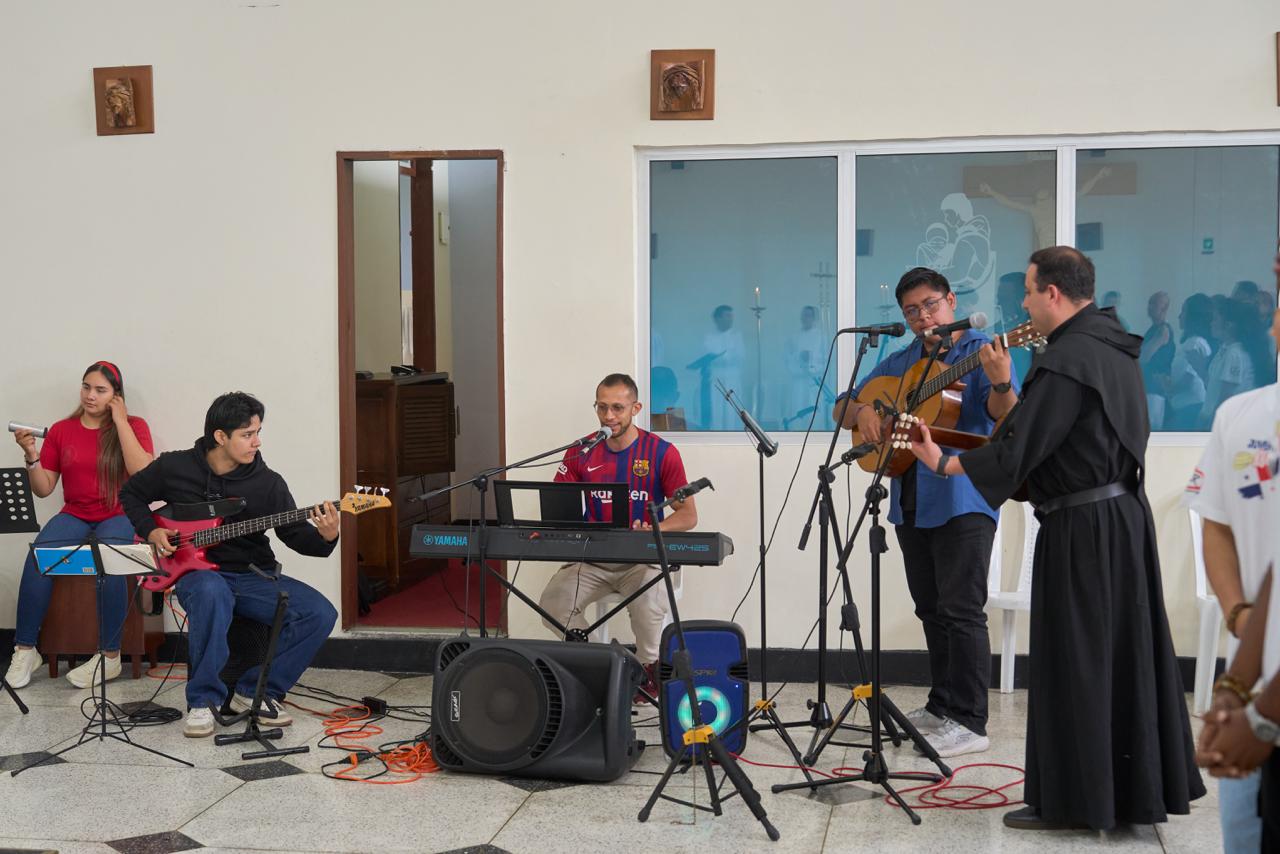
The catechesis also recalled the importance of the schola cantorum, the choir responsible for performing its assigned parts and helping the faithful actively participate in the singing.
Its mission is not to replace the assembly or to turn the liturgy into a concert. The choir must support, guide, and enrich the prayer of the entire community.
To fulfill this task, good musical and liturgical formation is needed. Hence, the Council asks for it to be promoted in seminaries, novitiates, centers for religious studies, and Catholic schools, as well as among composers, musicians, and singers.
Pope Leo XIV’s final invitation: “Become a choir”
To conclude, the Pope recalled an image from Saint Ignatius of Antioch: every Christian is called to become a choir so that, living in harmony and concord with others, all may sing to the Father with one voice through Jesus Christ.
This image summarizes the teaching of the audience: sacred music does not only seek to produce beautiful sounds. It seeks to build communion, express faith, and unite the lives of Christians in one single praise.
Greetings to Spanish-speaking pilgrims
At the end of the general audience, Pope Leo XIV especially greeted Spanish-speaking pilgrims and invited them to contemplate liturgical singing as a symbol of ecclesial communion.
He also asked the Lord to help Christians live in harmony and concord, like a single choir whose melodies and good works glorify the Father through Jesus Christ.
In a nutshell
Pope Leo XIV’s catechesis leaves three main teachings:
- Singing at Mass is a way to pray and participate in the liturgy.
- Sacred music should help the community unite and draw closer to God.
- Musical beauty is at the service of faith, not spectacle.
The next time we sing during Mass, we can remember that our voice is not alone: it joins that of the entire Church to form a single choir.