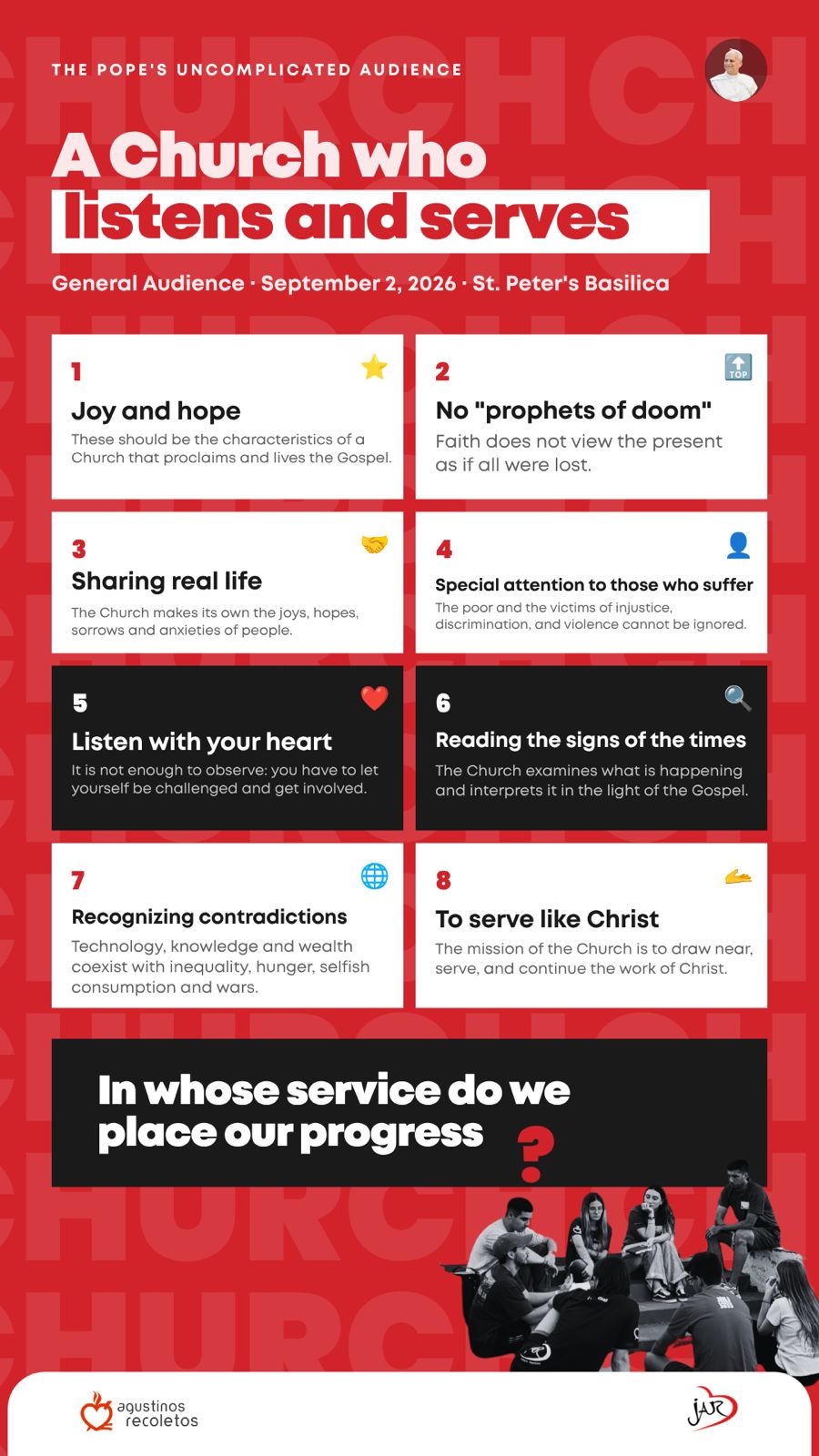

In the General Audience of September 2, 2026, Pope Leo XIV began a new series of catechesis on the pastoral constitution Gaudium et Spes. His central message is clear: the Church must listen to the world, share people’s difficulties, and serve especially those who suffer.
After concluding his reflections on sacrosanctum-concilium, Pope Leo XIV began a new document from the Second Vatican Council at the General Audience on September 2, 2026: the pastoral constitution Gaudium et Spes.
This document addresses a fundamental question: the relationship between the Church and the contemporary world.
Put simply, the question is this: how can the Church listen to, accompany, and serve people in the midst of everything happening in the world?
No “prophets of doom”
The Pope recalled that Saint John XXIII had already warned about “prophets of doom”: people who look at the present as if everything were worse than before and as if history had nothing to teach us.
The Christian response does not consist of ignoring problems or naively thinking that everything is fine. It consists of trying to discover how God’s Providence acts even in the midst of adverse events.
Gaudium et Spes does not propose a naive optimism. It proposes looking at reality from the mystery of Christ, who wanted to fully share our life.
Christ became “like his brothers in every way” and gave his life “as a ransom for all.” That closeness of Christ to humanity is also the path that the Church must follow.
Joys, hopes, sorrows, and anxieties
The beginning of Gaudium et Spes contains one of the document’s best-known expressions: the Church feels as its own “the joys and the hopes, the griefs and the anxieties of the men of this age, especially those who are poor or in any way afflicted.”
This means that the Church cannot remain indifferent to history and the concrete lives of people.
It cannot contemplate injustice, discrimination, or violence from afar. It is called to listen with the heart, let itself be challenged, and get involved.
Christians must take responsibility for the difficulties of their brothers and sisters, especially those who find themselves crushed by suffering and injustice.
Observing is not enough: you have to get involved
The Pope stated that we cannot remain as disinterested spectators in the face of the rapid and profound changes of our time.
Truly listening implies allowing reality to question us. It also requires sharing the difficulties of others and working to find appropriate answers.
That Christian commitment is sustained by a hope: “The sufferings of this present time are not worth comparing with the glory that is to be revealed to us.”
Christian hope does not serve to escape from problems. It gives us the strength to enter into them, accompany those who suffer, and work for concrete answers.
Reading the signs of the times
Closeness to people allows for a deeper understanding of events and also of Revelation.
For this reason, Gaudium et Spes recalls that the Church has the permanent duty of “scrutinizing the signs of the times and of interpreting them in the light of the Gospel.”
It is not simply about following fashions or accepting everything that happens. It is about listening, discerning, and observing reality from the Gospel.
This process also requires that the Church itself be willing to undergo continuous conversion.
The Church is not moved by earthly ambition. Its mission is to continue the work of Christ: to bear witness to the truth, to save and not to condemn, to serve and not to be served.
The poor are not a secondary issue
The Pope took up a teaching from Francis: for the Church, the option for the poor is a theological category rather than a cultural, sociological, political, or philosophical one.
Christians are called to discover Christ in the poor, to lend them their voice, to become their friends, to listen to them, and to understand them.
This means that the poor are not only people to be helped from afar. They can also communicate a wisdom to us that we must learn to welcome.
Serving them is part of the way the Church lives its relationship with Christ.
The contradictions of our world
Sharing the life of humanity also forces us to recognize the contradictions of our time.
The Pope mentioned several examples:
- Scientific and technological progress offers new possibilities, but they do not always reach everyone or truly put themselves at the service of the human being.
- We know the laws of social life better, but we still have doubts about the direction we should take.
- More wealth and economic possibilities exist, while many people continue to suffer from hunger and misery.
- We know that the future of the planet is at stake, but we find it hard to give up selfish consumption.
- We desire peace, but we can still fall into the illusion that war is an effective means to build it.
Progress, by itself, does not solve all our problems. It is necessary to ask ourselves whose service we put our knowledge, resources, and decisions into.
A Church that listens and serves
In the midst of these changes and imbalances, the Church is called to serve the human being.
To do so, it must listen to and welcome the deepest questions that dwell in people’s hearts.
Its response is not a theory far removed from life. The Church points to Christ as “the key, the focal point and the goal of man, as well as of all human history.”
Furthermore, it is called to follow the path of Christ, who “emptied himself, taking the form of a slave” and was obedient “unto death, even death on a cross.”
The Church serves the world when it abandons indifference, draws close to people, and adopts the humble and merciful attitude of Christ.
Final greetings: joy, hope, and closeness
In greetings to pilgrims of different languages, the Pope insisted that joy and hope must be the face of a Church that announces and lives the Gospel.
He also highlighted dialogue and cooperation, evangelization, the search for true life, pastoral closeness, and attention to people’s legitimate aspirations.
He especially invited everyone to draw close to the poor and those who suffer, to become witnesses of the Gospel full of joy and hope.
Speaking of the new generations, he recalled the collaboration between families, the school, and the Church in education. He also encouraged parish groups to model their lives according to the Gospel and to sow Christ’s love in society.
Saint Gregory the Great: a greatness born of faith
Addressing young people, the sick, and newlyweds, the Pope recalled that the memory of Saint Gregory the Great would be celebrated the following day.
He explained that he was called “the Great” for his extraordinary work as a pastor at a very difficult time for society and for the Church.
But his greatness did not come from power or prestige. He received his strength from a living faith in Christ.
The Pope invited everyone to follow his example and to renew their trust in God, the source of grace and hope for the whole world.
The idea made simple
The Church is not called to observe the world from a comfortable or distant position.
It is called to listen with the heart, let itself be challenged, draw close to those who suffer, and work for concrete answers.
This does not mean naively accepting everything that happens. It means reading the signs of the times in the light of the Gospel and putting our knowledge, possibilities, and resources at the service of people.
Put simply: the Church shares the joys and the wounds of the world because it wants to continue the work of Christ.
Its face must be that of a close, humble, and servant Church. A Church marked by two words: joy and hope, gaudium et spes.