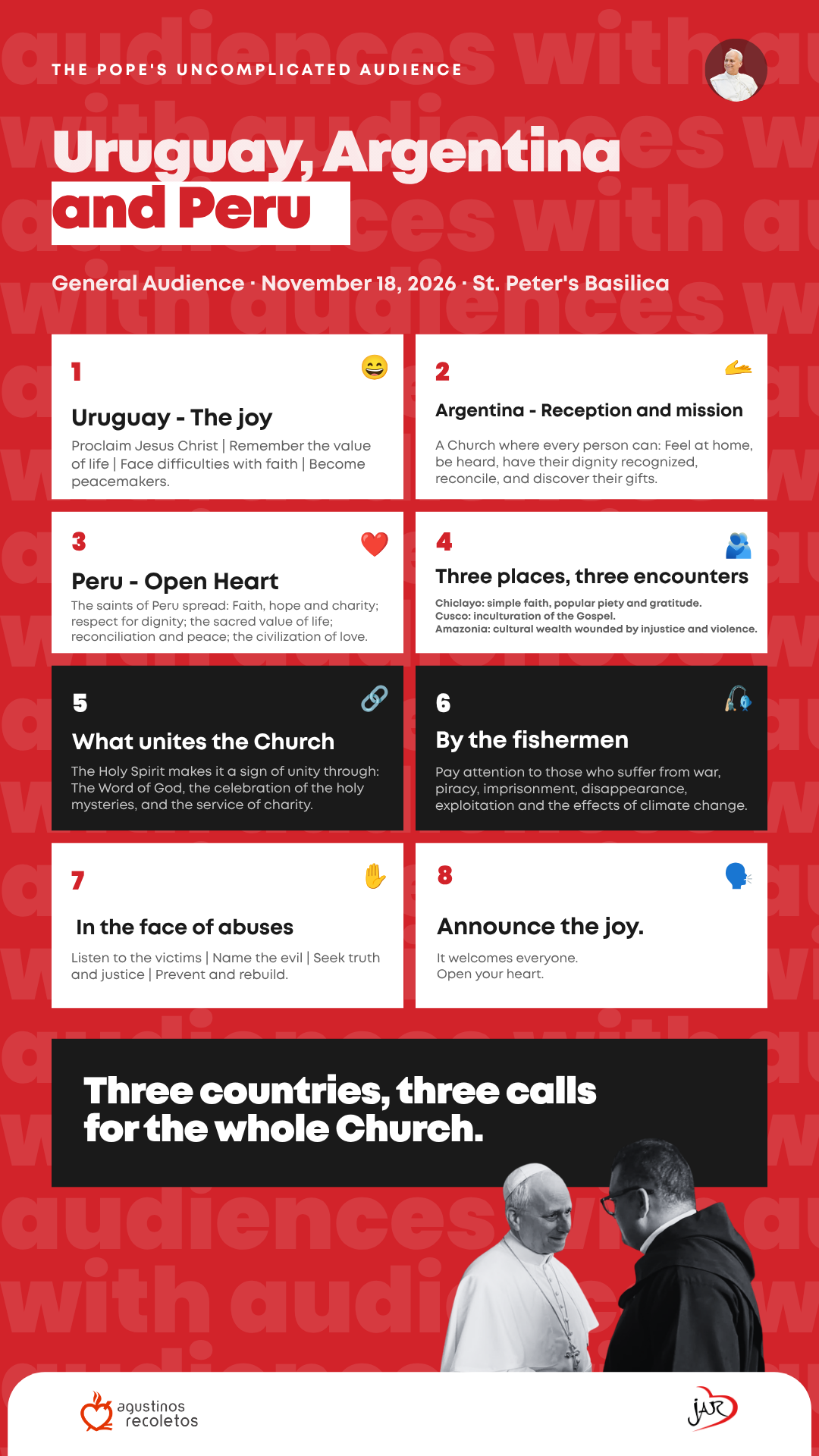

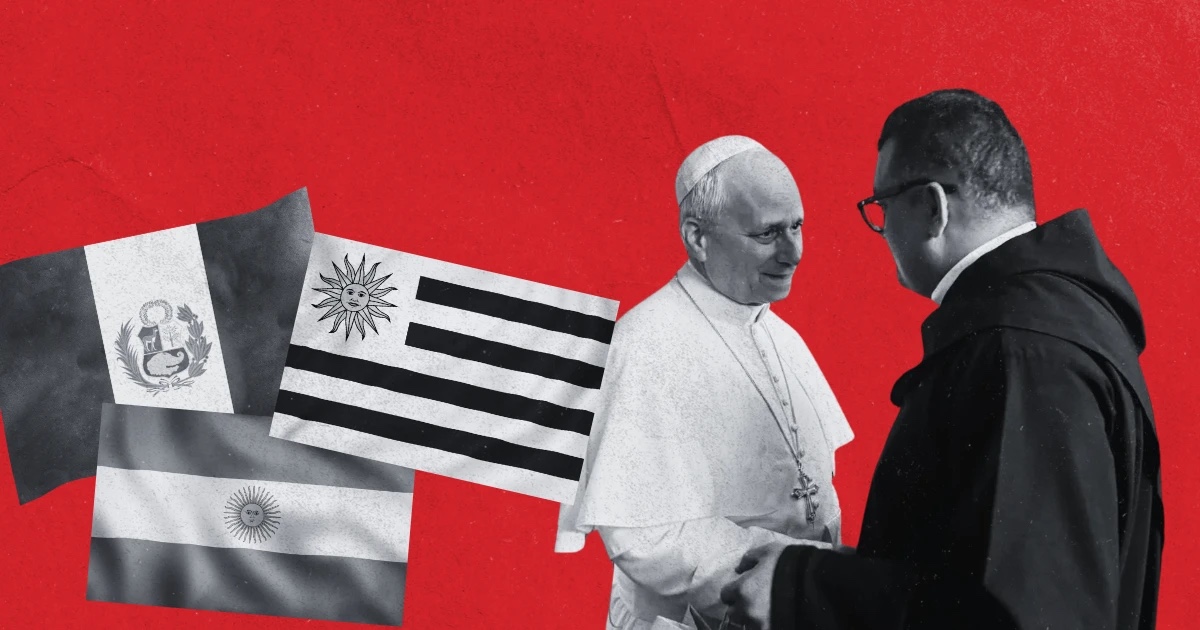
Summary: During the General Audience on November 18, 2026, Pope Leo XIV looked back on his apostolic journey to Uruguay, Argentina and Peru. Each country left a concrete call: proclaim the joy of Christ, build a Church where everyone finds a home, and open our hearts to God and to our neighbor.
Pope Leo XIV returned to Rome after a long apostolic journey through Uruguay, Argentina and Peru. At the General Audience on November 18, he explained what he had found in each country and what message he had wanted to leave with its people.
The three stages had different features, but they were united by faith, hope and charity. The Pope met communities that, despite their difficulties, are trying to build peace, defend human dignity and live the joy of the Gospel.
A journey with very personal ties
Peru holds a special place in the life of Leo XIV, because he lived there for many years as a missionary and later as a bishop. Argentina, for its part, is the homeland of Pope Francis, and Leo XIV wanted to meet the people his predecessor had loved so deeply.
Uruguay was the starting point of the journey and brought a different reality: Catholics there live as a minority. Beginning precisely in that country showed that the value of a Christian community does not depend on its size, but on its ability to proclaim Christ and bear witness to the faith.
Uruguay: proclaiming a great joy
The motto of the visit to Uruguay was a phrase from the Gospel of Luke: “I bring you good news of great joy.” These are the words with which the angel announces the birth of Jesus Christ to the shepherds of Bethlehem.
The Pope explained that he travelled to Uruguay to proclaim Jesus, God made man, who offers the fullness of life in truth and love. The warm and participatory welcome of the Uruguayan people allowed him to recall the importance of faith in God, the value of every human life, and the help that faith offers in facing difficulties.
Christian joy does not mean ignoring problems. It becomes the strength to get through them and the drive to work for peace.
Argentina: a Church with open doors
The motto of the Argentine stage was “Welcome, everyone! Go and proclaim!” These words capture the vision of the Church handed on by Pope Francis: a welcoming Church, open to all, where every person can feel at home.
To welcome means listening to each person, recognizing their dignity, helping them be reconciled with God, with themselves and with the community, and valuing both their abilities and their limits. It is not simply about letting someone in, but about helping them discover that they are part of a community.
Welcoming and going out to proclaim
Welcome cannot turn the Church into a community closed in on itself. The second movement of the Argentine motto is missionary: after receiving and accompanying, we must go out and proclaim.
The Pope presented a Church that finds its coherence and its joy in evangelization. In Argentina he found an enthusiastic participation of the people of God and encouraged them to cultivate communion without erasing the richness of differences.
He also asked them to work for a just and supportive society according to the principles of the Church’s social doctrine. Christian mission thus unites the proclamation of the Gospel with a commitment to dignity and justice.
Peru: opening the heart
The visit to Peru was longer because of the personal bond and gratitude the Pope feels toward its people. The chosen motto was “Let us open our hearts!”, an invitation to make room for the Holy Spirit following the example of the saints.
Leo XIV recalled Saint Turibius of Mogrovejo, Saint Rose of Lima, Saint Francis Solanus, Saint Martin de Porres and Saint John Macías. Their presence and their work spread faith, hope and charity, but also respect for human dignity, the sacred value of life, reconciliation and peace.
Building the civilization of love
The Peruvian saints did not leave behind just a memory of the past. Their witness lives on in those who open their hearts to God and to their neighbor and work for a more just and fraternal Peru.
The Pope described their work as a contribution to the civilization of love. That civilization is built when faith becomes respect for life, defense of dignity, reconciliation and concrete service to others.
During this stage, Leo XIV also met personally with victims of abuse. This gesture connects opening one’s heart with the willingness to listen to those who have been wounded and to walk with them.
Chiclayo: coming home
In Chiclayo, the Pope said he felt at home. There he rediscovered a simple and authentic faith, nourished by popular piety, and received the embrace of the farming communities of the mountains.
He was also able to see again people who left a deep mark on his life. The encounter filled his heart with gratitude and allowed him to confirm those communities in faith and hope.
Cusco and the Amazon: Gospel, culture and wounds
In Cusco, Leo XIV contemplated the fruits of the inculturation of the Gospel carried out by the missionaries. Faith had not erased the local culture, but had entered into relationship with it and produced its own expression.
In the Amazon region he met peoples rich in traditional culture, but also wounded by injustice and violence. Cultural beauty and suffering can coexist in the same land, and the Church is called to recognize both and to accompany people.
The beauty of a people on the move
Apostolic journeys allow the Pope to contemplate the beauty of the people of God in different historical and cultural circumstances. Although each local Church faces its own difficulties, the action of the Holy Spirit can be recognized in all of them.
The Spirit helps the Church to be a sign and instrument of unity through listening to the Word of God, celebrating the sacraments and serving in charity. These three dimensions hold very different communities together.
Mary accompanied the whole journey
The Virgin Mary was constantly present in all three stages. The Pope explained that Mary is part of the history of these peoples: she walks with them, guides them and consoles them.
Leo XIV thanked her for her protection and entrusted to her intercession all the people who welcomed and supported him during the journey. He also asked her to always guide Uruguay, Argentina and Peru along the path of the Gospel.
The final greetings: rekindling faith
In his greetings to pilgrims of different languages, the Pope invited everyone to be witnesses of faith, hope and charity. He also asked that the vitality of the Gospel seen in Latin America might help sustain and rekindle faith in other places.
He thanked the Spanish-speaking pilgrims for their prayers for the journey and for the work of those who helped make it possible. Leo XIV once again entrusted the three countries he visited to the protection of the Virgin Mary.
The witness of Blessed Karolina
In his greeting to Polish pilgrims, the Pope recalled Blessed Karolina Kózkówna, a young martyr who gave her life in defense of chastity.
He prayed that her faithfulness to God and her witness to human dignity would help young people in particular. Her example can accompany them in their search for truth, for the meaning of life and for their own dignity in Christ.
An appeal for fishermen
Ahead of World Fisheries Day on November 21, the Pope remembered fishermen exposed to war, piracy and imprisonment. He also kept in mind those who have disappeared at sea and their families, who are still waiting for news.
Leo XIV also mentioned migrant and exploited fishermen, as well as coastal communities affected by climate change and by an increasingly impoverished sea. His appeal shows that the work and lives of these people must not remain invisible.
Listening to heal and rebuild
The audience coincided with the Italian Day of Prayer for victims and survivors of abuse. The chosen motto was “Listening that heals, a community that rebuilds.”
The Pope explained that preventing and combating abuse is part of the Gospel conversion of the Christian community. This path must begin by listening to those who have been wounded, calling evil by its name, and undertaking processes of truth, justice and rebuilding.
There can be no renewed community if wounds are hidden or victims are not heard. Rebuilding requires acknowledging the harm and acting to prevent it from happening again.
The idea made simple
Uruguay, Argentina and Peru left three invitations that any Christian can apply: proclaim the joy of Christ, welcome every person, and open our hearts to God and to our neighbor.
A welcoming Church does not simply say that everyone can come in. It listens, recognizes dignity, tends to wounds and helps each person discover their gifts. And a missionary Church does not stay comfortably at home, but goes out to proclaim and to work for a more just and fraternal society.
Opening our hearts also means listening to victims, protecting those who are exploited and not ignoring injustice. Faith, hope and charity become credible when they transform the way we treat people.