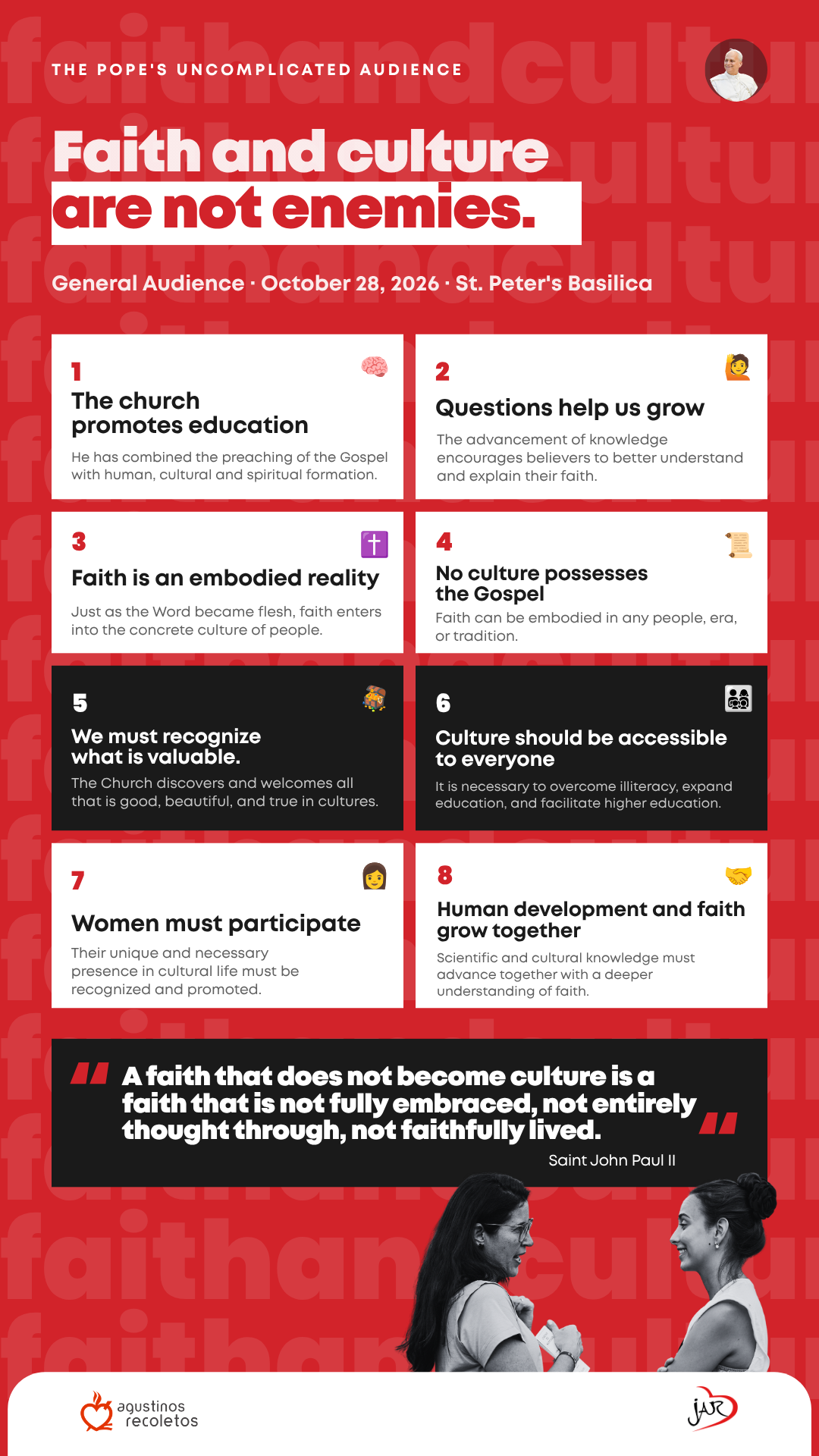

Summary: In the seventh catechesis on Gaudium et spes, the Pope explained that the Christian faith must not confront culture or remain isolated from it. It is called to enter language, art, science, education, and everyday life to transform every culture from within through charity and service.
Do faith and culture belong to different worlds? To believe, must one distrust science, thought, art, or the various human traditions? In this new catechesis on the pastoral constitution Gaudium et spes, the Pope answered no.
The Church is not called to turn its back on culture or to relate to it with hostility. Faith must dialogue with the real world in which people live, understand how they think and feel, and communicate the Gospel in a way that can be understood and welcomed.
The Church also creates culture
The Church’s concern for culture is nothing new. Over time, it has joined the preaching of the Gospel with the founding of schools aimed at promoting the human, cultural, and spiritual formation of men and women on every continent.
The Pope also recalled that medieval universities were born within the Church and contributed decisively to the development of Western civilization. Education, then, is not something secondary to the Christian mission, but a service to the integral growth of the person.
Learning more can also strengthen your faith
The progress of culture and knowledge generates new and increasingly profound questions. These questions should not frighten the believer, but rather encourage them to better understand what they believe and to be able to give an account of their faith.
The various cultural expressions arise from the spiritual dimension of the human being. Art, poetry, thought, and science can open the mind to the enduring questions about the world and existence, thus preparing a path to welcome the Gospel.
The Incarnation changes our relationship with culture
The relationship between faith and culture is rooted above all in the Incarnation. The Word of God “became flesh and dwelt among us”; for this reason, the Christian faith cannot remain an abstract idea, separate from life and history either.
Faith is an incarnate reality and is interwoven with the culture in which it lives. It is called to reach people through human words, traditions, religious expressions, art, poetry, thought, and science.
When faith becomes culture
The Pope recalled a statement by Saint John Paul II: “A faith that does not become culture is a faith not fully embraced, not entirely thought through, not faithfully lived.” This does not mean that faith should become a trend or be identified with a particular culture.
It means that what we believe must enter into our way of thinking, expressing ourselves, relating to others, and building society. If faith does not touch real life, it remains incomplete in the way we embrace, understand, and live it.
The Gospel does not belong to a single culture
The Christian faith can take root in any culture because it is not exclusively identified with any single one of them. It does not belong to one race, nation, era, custom, or way of life.
The Church can enter into communion with different cultures and recognize in them all that is good, beautiful, and true. At the same time, the Gospel transforms them from within according to the form of Jesus Christ, through charity, service, and the recognition of God as Father.
An encounter that enriches everyone
The relationship between the Church and cultures need not destroy the identity of either one. The Church transmits the Gospel within each culture and, at the same time, is also enriched through that encounter.
Cultures can receive a new light from the Gospel without losing all that is true and valuable within them. In this way, faith does not act as a force that erases differences, but as a presence capable of embracing them and directing them toward Christ.
Culture should not be a privilege
The Church promotes culture because it recognizes that it is a good in itself and a service to the person. That is why Gaudium et spes asks the international community to guarantee everyone’s access to fundamental cultural goods and to work to overcome illiteracy and lack of education.
The Council also states that people with the ability to pursue higher studies must be given the conditions necessary to actually do so. Talent should not be blocked by a lack of opportunities.
Women’s participation is necessary
Gaudium et spes expressly states that everyone must ensure that women’s own and necessary participation in cultural life is recognized and promoted. This is not presented as an optional concession, but as a requirement for the development of culture.
A society cannot build a fully human culture while it prevents or hinders part of its members from contributing their abilities, knowledge, and perspectives.
Believing does not let you stop studying
Christians are called to seek a deep unity among the different fields of knowledge. Even though they have received from Revelation answers to the great questions of existence, this does not free them from the need for patient intellectual and cultural formation.
Human and scientific knowledge must advance together with the understanding of faith. As a person grows and progresses in their studies, they also need to deepen what they believe, so as not to be left with a childish religious formation disconnected from their intellectual development.
Theology cannot close in on itself
The Council issues a special invitation to those dedicated to theology. It asks them to collaborate with specialists from other fields, sharing abilities, questions, and points of view.
Theological research must continue to deepen revealed truth, but without losing touch with its own time. Only in this way can it help those working in the different branches of knowledge reach a deeper understanding of the faith.
Neither hostility nor uncritical acceptance
Gaudium et spes recommends not living out the faith from a stance of opposition or hostility toward the world, culture, and its human expressions. Christians must live closely united with the people of their time and strive to understand their ways of thinking and feeling.
Understanding does not mean automatically accepting any and every cultural expression. It means listening, dialoguing, recognizing what is good, beautiful, and true, and communicating the Gospel within the concrete reality of each person.
A credible faith in the real world
Achieving a mature and responsible synthesis between faith and culture is necessary to persevere in the Christian vocation. It is also essential for bearing witness to faith and communicating it credibly.
A faith that does not engage with the questions, knowledge, and expressions of its time risks becoming an incomprehensible discourse. A culture that closes itself off from spiritual questions can also lose an essential dimension of the human experience.
Greeting to Spanish-speaking pilgrims
In his greeting to Spanish-speaking pilgrims, the Pope encouraged them to become promoters of culture in the different areas of life and society, starting from the values of the Gospel.
This invitation sums up the catechesis: Christians are not called merely to consume culture, criticize it from the outside, or hide from it. They are called to take part in its creation and development, bringing to it the gaze of the Gospel.
The idea made simple
Faith does not live in a bubble. It enters into your way of speaking, studying, thinking, creating, researching, and relating to others. If it does not touch these areas, it has not yet come to fill your whole life.
Being Christian does not mean opposing science, art, or culture. It means learning, dialoguing, and recognizing all that is good, beautiful, and true, without losing the identity of the Gospel.
You don’t have to choose between thinking and believing. You need to form your intellect and deepen your faith so that both grow together, allowing you to communicate what you believe in a mature and credible way.