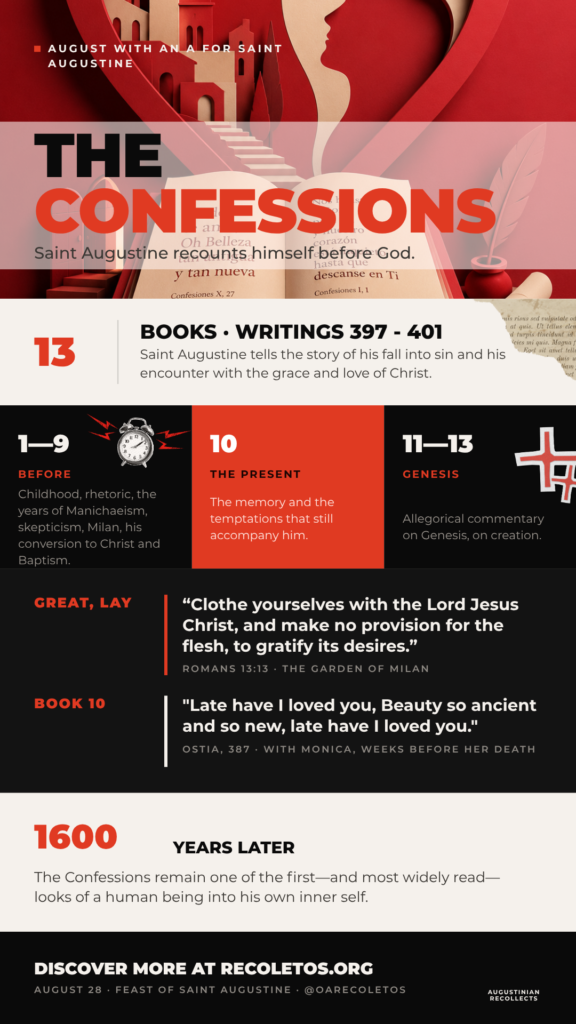

What if a book written more than 1,600 years ago still spoke directly into your life? Saint Augustine’s Confessions are not just the story of a saint: they are the account of a search, an inner struggle, and the discovery of God. Written between 397 and 401, they remain one of the most read and influential works in Christianity.
Three parts, one single movement
The Confessions aren’t read like an autobiography in the usual sense. They are built in three clearly distinct blocks.
Books 1 to 9 trace Augustine’s life before his conversion: childhood, the years devoted to rhetoric, almost a decade tied to Manichaeism, a period of skepticism, his arrival in Milan, his meeting with Saint Ambrose, his conversion, and baptism. It’s the most narrative part and also the best known.
Book 10 completely changes register. Augustine stops narrating the past to look at his present. He reflects on memory and acknowledges the temptations he still experiences, even as a bishop.
Books 11 to 13 leave the autobiographical narrative behind to offer an allegorical commentary on the Book of Genesis.
The moment that changed everything: “Take and read”
If there is one scene that sums up the whole work, it’s the one in the garden in Milan.
In the middle of a deep inner crisis, Augustine hears a child’s voice repeating a simple invitation: tolle, lege (“take and read”). He opens the Scriptures and finds a passage from Saint Paul’s Letter to the Romans: “Put on the Lord Jesus Christ, and make no provision for the flesh, to gratify its desires” (Rom 13:13). That moment marks the high point of his conversion.
Ostia: an experience shared with his mother
Soon after, while they wait to return to Africa, Augustine and Saint Monica share an intense spiritual experience together at the port of Ostia. It is one of the so-called Augustinian “ascents”: brief glimpses of the divine. Weeks later, Monica dies there, bringing Book IX to an end.
“Late have I loved you”: the line that never grows old
In Book 10 appears one of the best-known expressions in all of Christian literature:
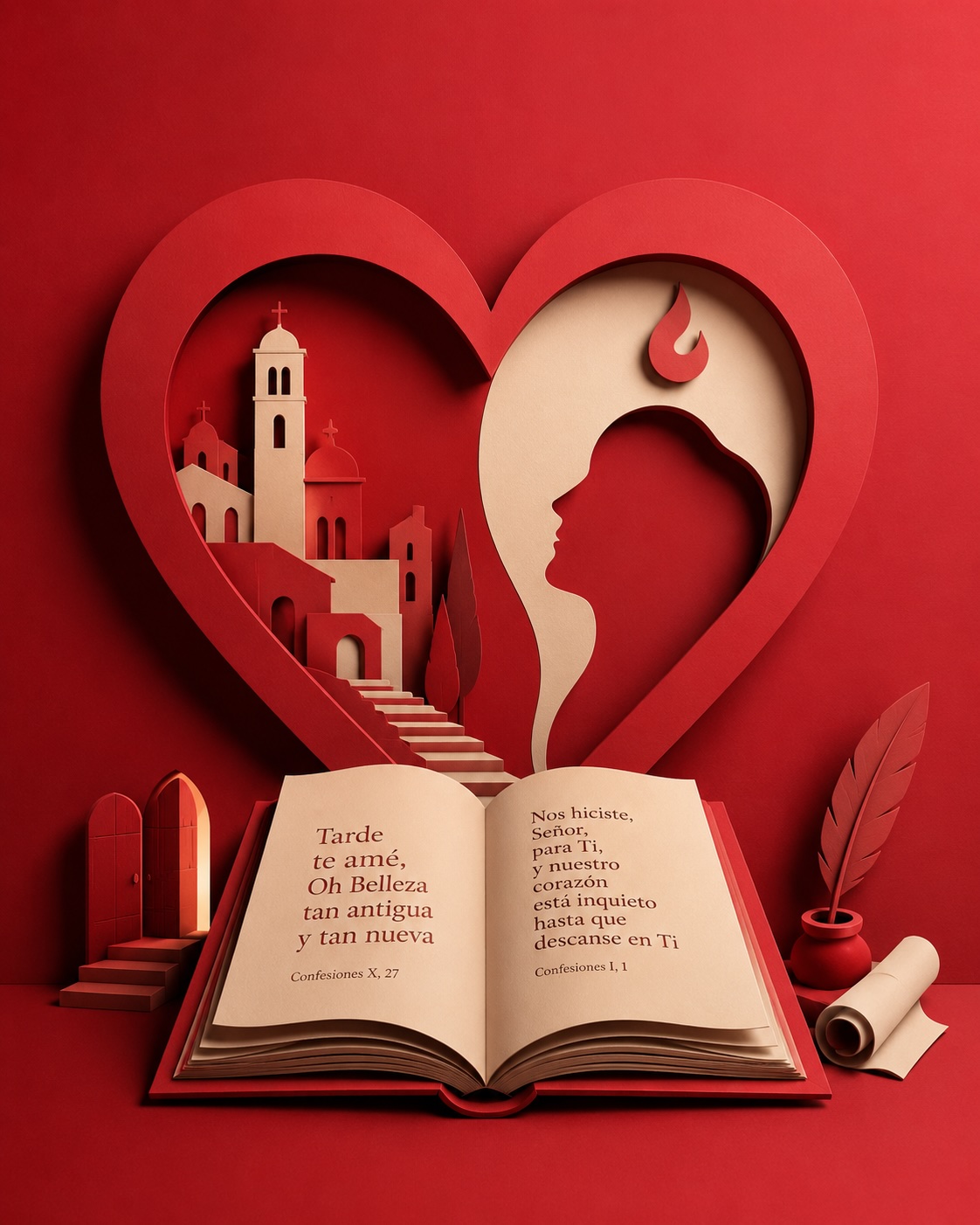
“Late have I loved you, Beauty so ancient and so new, late have I loved you!”
More than a famous line, it’s the summary of the whole work: the story of someone who discovers that God had always been waiting for him.
A classic that still speaks today
More than 1,600 years later, the Confessions remain one of the essential works for understanding the human heart. This August, on the feast of Saint Augustine, it may be the best time to open its pages and discover that his story can also shed light on ours.