
How can a text of just a few pages keep changing lives almost 1,700 years later? The Rule of Saint Augustine is not just one of the most important writings in Christian spirituality: it is the foundation on which thousands of religious communities have built their lives and an invitation, even today, to live out friendship, fraternity, and the search for God. Its influence reaches our days and continues to inspire young people all over the world.
A small text that changed history
There are books that are born to respond to a specific need and end up marking entire generations. That is what happened with the Rule of Saint Augustine.
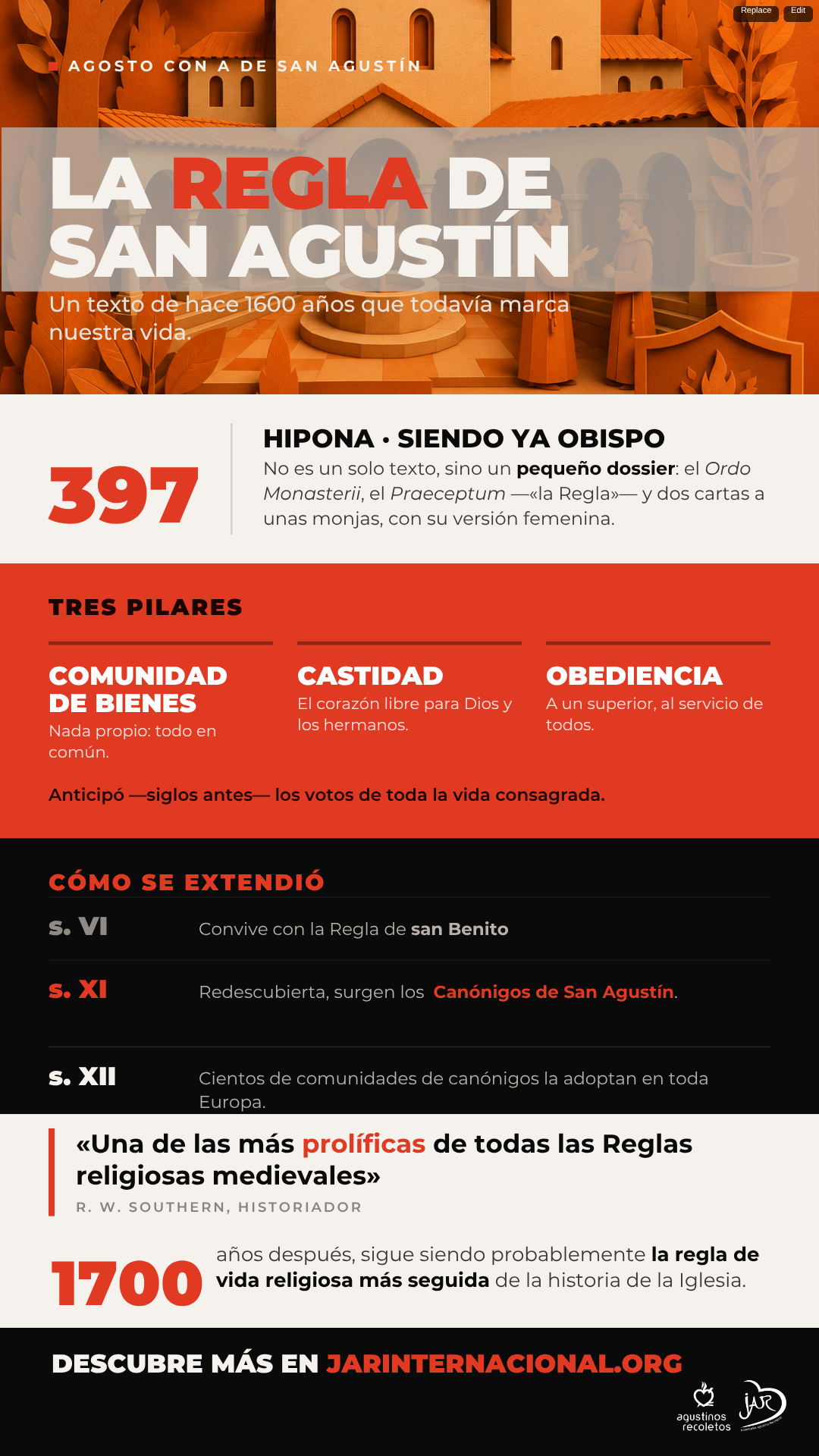
Written around the year 397 for the monastery of Hippo, it emerged at a decisive moment in Augustine’s life, when he had to leave the community he lived in upon being ordained a bishop. Those pages, intended to guide the daily life of a community, would end up becoming—as historian R. W. Southern stated—”the most prolific of all medieval religious Rules.”
What really is the Rule of Saint Augustine?
When we talk about the Rule, we are actually referring to a small set of writings.
Its core is the Praeceptum, the text we identify today as the authentic Rule of Saint Augustine. Joined to it were the Ordo Monasterii, of more debated authorship, and Letter 211 addressed to a community of nuns, where Augustine addresses their internal conflicts and offers a feminine adaptation of the Rule.
For centuries its authorship was debated. Today there is a broad consensus that the Praeceptum was written by Saint Augustine. Specialists have identified hundreds of coincidences with other writings by the Bishop of Hippo, including a term exclusive to his vocabulary: emendatorius. Furthermore, the oldest testimony expressly attributing the work to Augustine appears just a century after his death.
Three ideas that are still relevant today
The strength of the Rule is not in the number of regulations, but in the simplicity of its proposal.
All community life rests on three great pillars:
- living the community of goods;
- embracing chastity;
- obeying the superior.
Many centuries before the current formulation existed, Augustine was anticipating the three vows of consecrated life.
The rediscovery that changed Europe
During much of the Early Middle Ages, the Rule of Saint Augustine remained in the background. Many clerical communities followed another norm, written in the 8th century by Chrodegang, Bishop of Metz.
Everything changed in the 11th century.
Gregorian reformers sought to renew the life of the clergy and found two frequent problems: the possession of personal property and living outside of community. It was then that they rediscovered that Augustine had already offered an answer centuries before.
The enthusiasm was enormous. During the 12th century, hundreds of communities of canons regular adopted the Rule of Saint Augustine, both in contemplative monasteries and in communities dedicated to serving hospitals and parishes.
One Rule, many religious families
Since then, the history of the Rule also became the history of numerous religious families.
The Premonstratensians made it their own. In 1215, the Fourth Lateran Council established that new religious orders had to adopt an already approved rule, and Saint Dominic chose precisely the Rule of Saint Augustine for the Order of Preachers.
Centuries later, in 1588, the Recollect reform would be born from that same tradition, the origin of the Augustinian Recollects, our family.
Why might it interest a young person today?
The Rule of Saint Augustine doesn’t propose productivity techniques or formulas for success. It speaks of something much deeper: learning to live with others, sharing life, seeking the truth together, and putting God at the center.
In a culture where many people experience loneliness, individualism, or difficulty in creating lasting bonds, the Augustinian proposal remains surprisingly relevant.
Almost 1,700 years later, thousands of religious men and women continue to live according to these pages. And perhaps its greatest relevance is to remind us that no one is called to walk the path of faith alone.