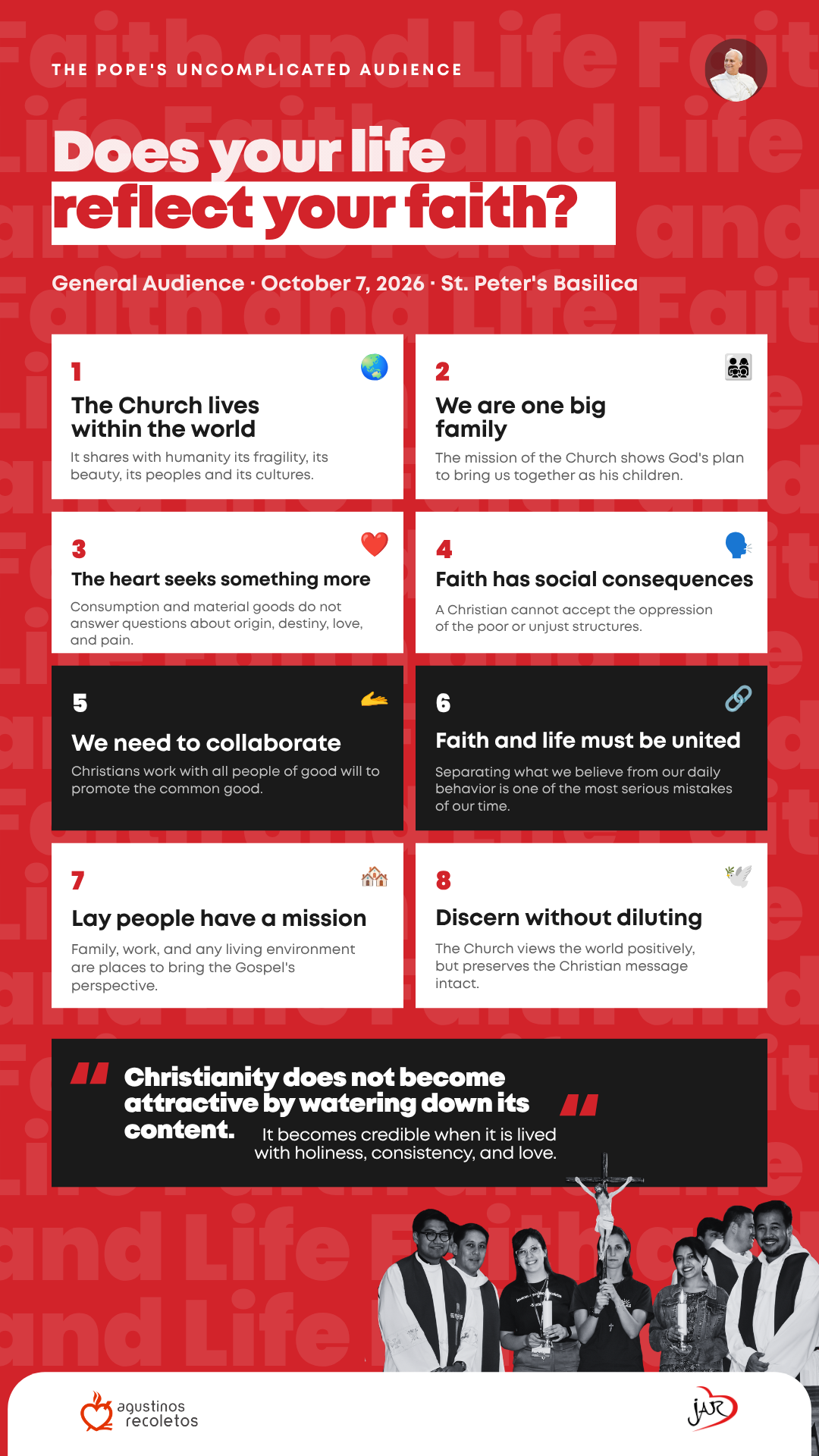

Summary: During the General Audience on October 7, 2026, Pope Leo XIV resumed his catecheses on Gaudium et spes. This week, he explained that the Church is neither above nor outside the world: it lives within it, and every baptized person must unite the faith they profess with their daily life.
After dedicating the previous audience to his apostolic journey to France, Pope Leo XIV resumed his review of the conciliar constitution Gaudium et spes on October 7, 2026.
This fifth catechesis was dedicated to the Church’s mission in the contemporary world.
The starting point is important: the Church is not “above” or “beside” the world. It is embedded within it.
Christians do not observe history from the outside. They walk within it, sharing the fragility and beauty of the world with others.
The Church is also part of the world
The Pope recalled an expression of Saint Augustine: “Mundus reconciliatus Ecclesia.” That is, the Church is the world already reconciled with God. In Sermon 96.
This means it is not formed by people who live detached from reality. Christians are also pilgrims on earth and share humanity’s joys, difficulties, cultures, and relationships.
Just as the Son of God became man to give life to the world and reconcile it with the Father, the Church lives within the world to show God’s plan: to make us his children and gather us into one great human family.
Its mission has a historical dimension. It also implies a concrete responsibility for how social relationships are built.
Questions No Purchase Can Answer
The Church’s primary mission is to help people pay attention to life’s profound questions:
- Where do we come from?
- Where are we going?
- What is the meaning of love?
- How do we face pain?
These questions can become hidden when life focuses exclusively on consumption.
The Pope warned against the logic of profit at any cost and the manipulation of information. Both can pressure people to adopt a lifestyle centered on accumulating material goods.
But the human heart is not made only to buy, produce, or consume.
“Our heart is made to look upwards,” the Pope affirmed.
Material things can occupy a place in life, but they alone do not answer our deepest questions.
Building Society is Also the Church’s Mission
The Church’s mission includes contributing to the building of society.
However, its methods and purpose are not primarily political. Its contribution begins with the testimony of faith and charity.
This testimony is expressed through commitment to:
- Justice.
- Peace.
- Fraternity.
- The common good.
A Christian who adores Christ, the Just One who died for the unjust, cannot accept the oppression of the small and the poor.
Nor can they remain indifferent to unjust structures that perpetuate situations of dependence. Faith leads to concrete social responsibility.
Working with All People of Good Will
The Church’s social doctrine guides the action of Christians. They are called to collaborate with all people of good will to promote the common good.
The Church does not seek privileges. It wants to serve the good of all and develop freely in any system that respects:
- The fundamental rights of the person.
- The rights of the family.
- The demands of the common good.
Its mission is not to impose an ideology, but to bear witness to faith and charity and to work for a more just, fraternal, and peaceful society.
The Big Problem: Saying One Thing and Living Another
To fulfill the mission of proclaiming the Gospel, every baptized person needs to collaborate with the grace of the Holy Spirit. Faith must be alive and expressed through coherent behavior.
Gaudium et spes offers a very clear warning: the separation between the faith a person claims to have and their daily life must be considered “one of the gravest errors of our time.” It is not enough to say we are Christians.
Faith must appear in:
- Our decisions.
- Our way of working.
- How we treat others.
- Our commitment to justice.
- Our pursuit of peace and the common good.
Simply put: if faith doesn’t touch your life, it ends up becoming just a label.
The Laity Are Not Spectators
The catechesis paid special attention to the mission of the lay faithful.
Through Baptism, they are called to bring the Christian spirit and the Gospel’s perspective into the world.
This mission is not limited to collaborating in activities within a church. Its primary spaces are family and work, but it extends to every environment of life.
The laity live their mission:
- At home.
- At work.
- In their relationships.
- In society.
- Wherever they make decisions and live with other people.
The mission does not begin when someone enters a temple. It continues wherever they live.
Looking at the World with Openness, But Without Losing the Gospel
The Church remains attentive to what happens and develops in society. All of God’s people, especially its pastors and theologians, must discern which elements of contemporary cultures deserve to be valued.
This discernment has the Word of God and the Tradition of the Church as its main criteria. The Pope asked for a balanced spirit: Free from cultural fads, capable of looking positively at the world, firm in preserving and presenting the Gospel integrally.
Having a positive outlook does not mean accepting everything without discernment. And being faithful to the Gospel does not mean automatically condemning everything new.
Christian balance avoids both extremes.
Christianity Does Not Become Attractive by Diluting It
Leo XIV recalled that Christianity does not become more attractive by diluting its content or softening its demands.
The Church’s mission is not to adapt the Gospel until it no longer causes discomfort.
Nor is it to present it without love, hope, or closeness.
The answer is to show its complete truth through a holy life and real charity.
Consistency makes the message credible.
Holiness and Love: The Language Everyone Understands
As it journeys through history, the Church has one sole objective: that the Kingdom of God may come and that all humanity may receive salvation.
It advances towards this goal especially through: Personal holiness, fraternal love.
The Pope quoted Saint Paul VI, who warned that, without the sign of holiness, the Christian word hardly finds its way into people’s hearts and risks becoming empty and fruitless.
Before convincing with speeches, Christians are called to bear witness with their lives.
Final Greetings: Sowers of Hope
In his greetings to pilgrims of different languages, the Pope invited them to look at people with a positive attitude and help them become sowers of hope in society.
He also recalled that Christians are called to bear witness to Christ through love, justice, and peace, building a world where the common good and fraternity prevail.
He encouraged Spanish-speaking pilgrims to listen to the inspirations of the Holy Spirit so that each person, from their own state of life, may collaborate in the coming of the Kingdom of God.
He also entrusted the pilgrims from Brazil and their families to the intercession of Our Lady of Aparecida, whose feast would be celebrated on October 12.
The Rosary: Refuge in Difficulties
The audience coincided with the liturgical memorial of the Blessed Virgin Mary of the Rosary.
Addressing young people, the sick, and newlyweds, the Pope recalled the importance of this Marian prayer, so beloved by the Church’s tradition.
He invited them to pray the rosary to experience the comfort of Mary, a safe refuge amidst life’s difficulties.
The idea made simple
The Church is not outside the world, and you don’t live your faith from the sidelines either.
Being a Christian is not about saying one thing inside the church and living a completely different way outside of it.
Your family, your work, your relationships, and your decisions are the places where faith becomes visible.
The Gospel does not need to be watered down to be attractive. It needs Christians who live it with consistency, holiness, and love.
The question is not only: “Do I have faith?”.
The question is also: “Does it show in how I live?”.