
Summary: In the General Audience of September 30, 2026, Pope Leo XIV reflected on his apostolic journey to France and UNESCO. Notre-Dame became the symbol of his message: wounds do not have to be the end; with collaboration, faith, listening, and hope, rebirth is possible.
Is it possible to rebuild yourself after being wounded? Can a community be reborn after going through a crisis?
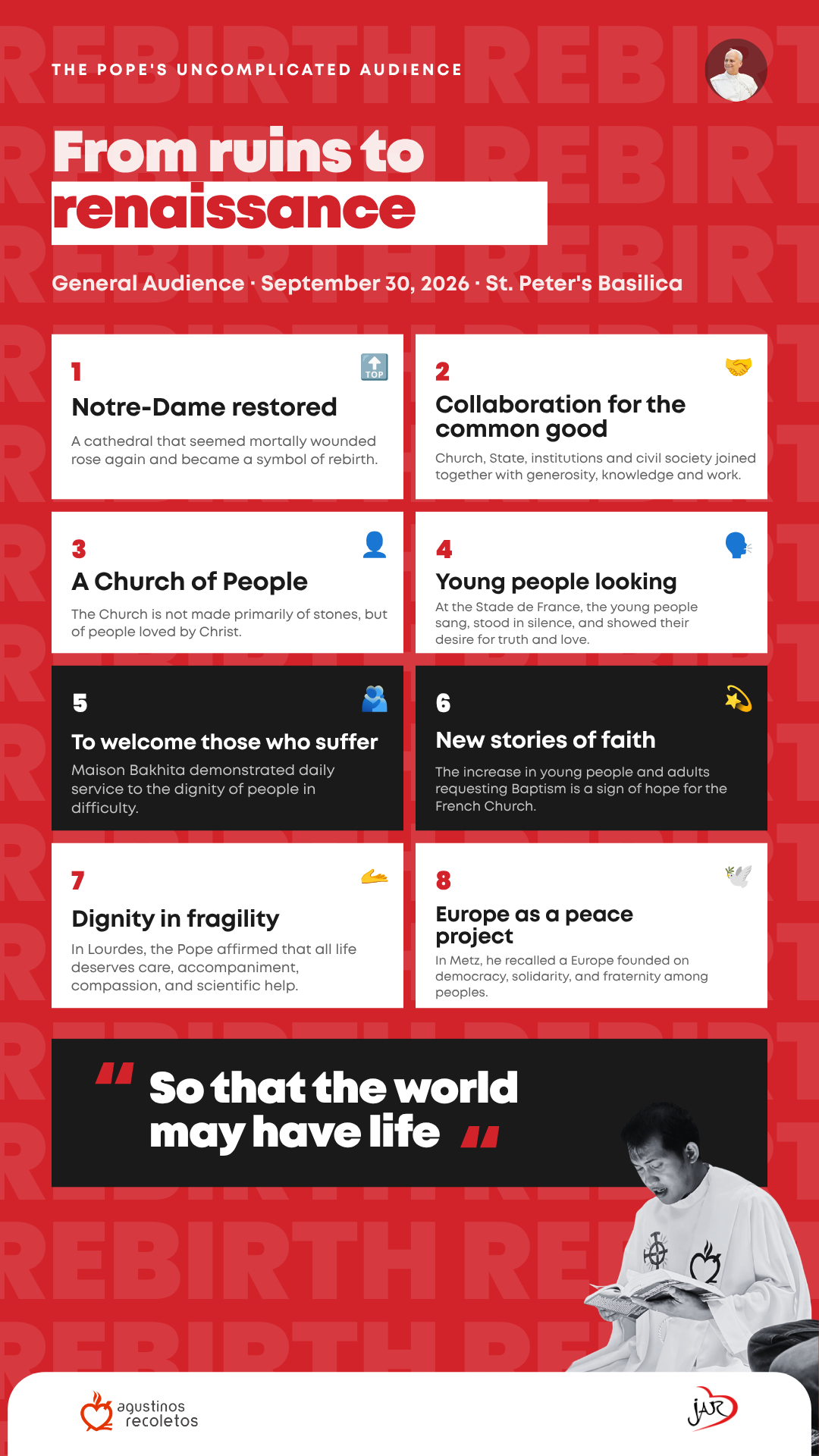
In the General Audience of September 30, 2026, Pope Leo XIV spoke about his apostolic journey to France and his visit to UNESCO. To sum up everything he experienced, he chose one image: the cathedral of Notre-Dame de Paris.
After the fire that seemed to wound it mortally, Notre-Dame was rebuilt and once again displayed its full splendor.
For the Pope, this process speaks not only of a building. It speaks of the possibility of rebirth.
Notre-Dame: from wound to rebirth
During the first day of the journey, the Pope celebrated vespers of the Virgin Mary at Notre-Dame.
The music, the singing, and the beauty of the temple united hearts in prayer. But the cathedral also preserved the memory of the tragedy it had suffered.
Seven years earlier it seemed mortally wounded by a massive fire. Now it stood rebuilt and more splendid than ever.
The disaster provoked a positive response on many levels. Some consequences were visible and practical; others, more hidden and spiritual.
From that story emerged the word that sums up the journey: rebirth.
Rebuilding together works
The restoration of Notre-Dame demonstrated that collaboration is possible.
The Church, the State, public institutions, and civil society worked together. The generosity of benefactors and the skills of professionals and workers also came together.
The Pope proposed this collaboration for the common good as a habitual style for:
- Institutions.
- Political forces.
- Social actors.
- Those with civil and economic responsibilities.
It is not about collaborating only when a catastrophe occurs. It is about learning to work together habitually.
The fundamental criterion that should guide this cooperation is the dignity of the human person. This was also the message that Leo XIV presented to French authorities and UNESCO members.
The Church is not made of concrete
Notre-Dame is a building, but it also represents something deeper: the Church formed by “living stones.”
The Pope compared two very different encounters.
In the cathedral he celebrated vespers with priests, deacons, consecrated persons, and pastoral workers. That same night he took part in a vigil with young people at the Stade de France.
A cathedral and a stadium. Two completely different spaces, but spiritually united by the same Church.
The Church is not formed primarily by stones or concrete. It is formed by people who love Jesus Christ because they have first been loved by Him.
Young people who sing and also know how to listen
In the stadium, the young people sang and shouted, but they also remained silent and listened.
The Pope found attentive and moved faces, the expression of hearts that desired truth and love.
That is why he told them:
“You are the saints of France!”
The youth of those who participated was not measured only by age. The Pope especially highlighted their spirit, their interior freedom, and their faith.
The vigil was for him a great sign of hope.
Hope is also reborn in small places
Not all the signs of the journey were massive gatherings.
Leo XIV visited Maison Bakhita, a house that welcomes people going through different difficulties.
In that small place, people work daily to serve human dignity with love.
The Pope presented it as one of the many fruits of the Gospel. The Church is also reborn there where a person is welcomed, cared for, and accompanied.
Rebirth does not always begin with something spectacular. Sometimes it begins in a house open to those who need help.
People asking for Baptism
Another sign of rebirth in the French Church is the increase in young people and adults requesting to receive Baptism.
In Paris a provincial synodal assembly was being held to reflect on this reality.
The Pope encouraged the journey of the catechumens, of those who had been baptized recently, and of the Christian communities to which they belong.
This “surprise” of God shows a Church that is reborn not only by rebuilding buildings, but by accompanying new stories of faith.
The true reconstruction of the Church
The culminating moment of the visit to Paris was the Mass celebrated in the Place de la Concorde.
The assembly extended from the square along the Champs-Élysées, to the Arc de Triomphe and beyond.
At the moment of Communion, the Eucharist could be distributed in all those places.
For the Pope, that was the true reconstruction: the restoration of the Church that only God can accomplish, with the intercession of the Virgin Mary.
The Church is rebuilt when the people of God gather, celebrate, and receive Christ.
Lourdes: every life retains its dignity
After Paris, Leo XIV made a pilgrimage to Lourdes to venerate Mary, Mother of the Church.
There, the Virgin keeps the lamp of faith and hope burning in the moment of passion and death.
Lourdes conveys a message of hope and rebirth especially to those who suffer in body or spirit.
The Pope insisted that every human life, in any condition and even in the gravest fragility, retains its inviolable dignity.
Every person deserves:
- To be cared for.
- To be accompanied.
- To receive relief for their suffering.
- To be treated with human compassion.
- To benefit from the means that science offers.
For this reason, Leo XIV presented Lourdes as a sanctuary of the civilization of love.
Listening to victims and walking with them
In Lourdes, the Pope also met with people who had suffered abuse.
He asked them to help him communicate to other victims his will and that of the whole Church to listen to them and walk alongside them as they seek healing.
This path requires recognizing the pain caused in their lives and working to prevent new abuses.
The rebirth of the Church cannot be built by hiding wounds. It needs listening, recognition of harm, accompaniment, and prevention.
Metz: a Europe born as a project of peace
The last stage of the journey was Metz, a region deeply scarred by the Second World War.
There worked Robert Schuman, one of the main drivers of the European unification process.
The Pope compared the fire at Notre-Dame with the destruction suffered by Europe during the war.
After that catastrophe, Europe was reborn as a project of peace based on:
- Democracy.
- Solidarity.
- Fraternity among peoples.
These principles owe much to European Christian roots.
In an increasingly globalized world, the European project needs to renew itself on those foundations. Interreligious dialogue occupies a fundamental place in that task.
In Metz, representatives of different religious traditions signed the “Appeal of Metz” for dialogue and peace.
The journey summed up in one phrase
The motto of the visit to France was a phrase of Jesus:
“So that the world may have life.”
These words sum up his saving mission and express the Gospel meaning of each encounter of the journey.
Reconstruction, welcome, listening, defense of dignity, and the search for peace only make sense if they help the world to have life.
The final greetings: let us not hide our faith
In his greetings to pilgrims of different languages, the Pope invited them to keep faith, hope, and charity burning.
He asked them to pray during October for peace among peoples and in the hearts of persons, and he encouraged families and parishes to rekindle the flame of faith.
He also recalled that the public witness of love for Jesus Christ seen in France can inspire the whole Church.
His invitation was direct:
“Let us not hide our faith.”
To the Spanish-speaking pilgrims he asked that, through the intercession of Our Lady of Lourdes, they keep the lamp of faith, hope, and charity burning, and live unity in Christ.
An appeal for peace in Tigray
The Pope expressed his deep concern over the return of hostilities in Tigray and in the nearby regions of Afar and Amhara, in Ethiopia.
He asked all parties to choose the path of dialogue.
Armed conflict never resolves problems. It aggravates them and leaves behind death, destruction, and resentment.
Only an honest commitment can build the foundations of a lasting peace.
Leo XIV also asked the international community for generous and timely collaboration to guarantee humanitarian aid to those who need it.
Three martyrs who drew near in the moment of trial
The Pope recalled the beatification in Bologna of three martyr priests: Ubaldo Marchioni, Elia Comini, and Martino Capelli.
They were murdered in 1944 because of the contempt of Nazi troops for their ministry on behalf of the members of their parishes.
Their sacrifice shows Christians today the value of drawing near to their brothers and sisters, especially in moments of trial.
October: a rosary for peace
Addressing the young people, the sick, and the newlyweds, the Pope asked that October be an occasion to pray the rosary.
He invited them to offer it especially for the end of wars and the coming of peace.
The idea made simple
Being reborn does not mean pretending there was never a fire.
It means recognizing the wound and deciding it will not be the last word.
Notre-Dame was reborn thanks to many people and institutions that worked together. The Church is reborn when its members gather, young people seek truth, those who suffer are welcomed, and victims find listening and accompaniment.
Europe too can renew itself when it chooses again democracy, solidarity, fraternity, and dialogue.
Ruins do not have to be the end. With faith, collaboration, truth, and care, they can become the place where a new life begins.